Ship Emergency Systems: A Complete Guide for Seafarers
A practical guide to key ship emergency systems, explaining their purpose, operation, and principal SOLAS requirements for safer emergency response at sea.
SeafarersHub Editorial Team••7 min read
Share
Ship Emergency Systems: A Complete Guide for Seafarers
Emergencies at sea can develop quickly. A machinery-space fire may cause a blackout, flooding may threaten essential machinery, and steering failure can immediately affect the safe navigation of the ship.
Ships are therefore provided with emergency systems and arrangements designed to maintain essential safety functions when normal systems become unavailable.
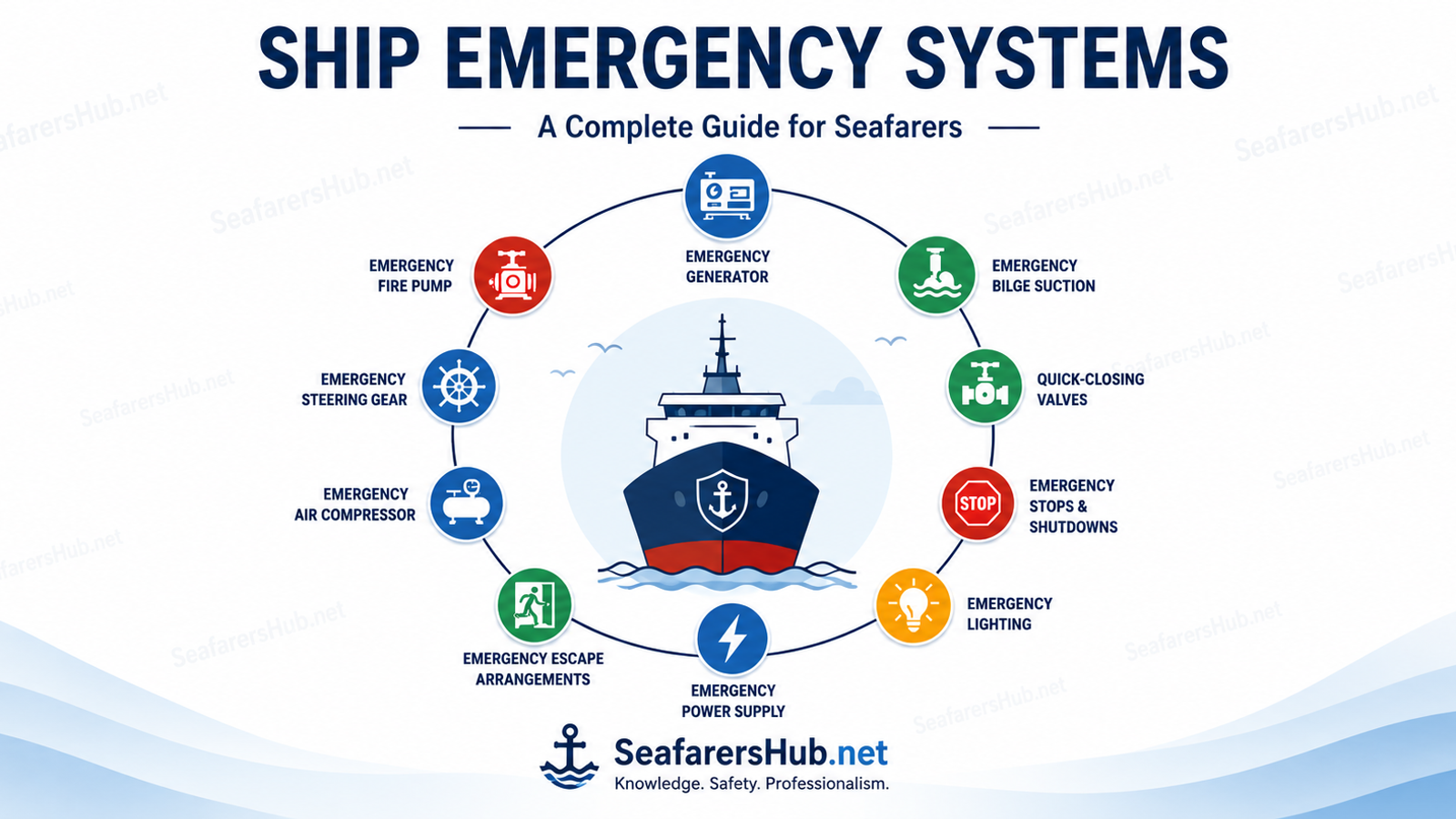
This guide introduces ten important ship emergency systems, explains their basic purpose, and identifies their principal requirements under the International Convention for the Safety of Life at Sea (SOLAS).
Regulatory basis: This guide uses the SOLAS Consolidated Edition 2024 as its primary source, together with applicable IMO supplements and amendments. ExactSOLAS regulations are identified where regulatory requirements are discussed.
Why Are Emergency Systems Important?
Shipboard systems depend on electrical power, machinery, pumps, fuel, ventilation and control systems. A serious casualty can disable several of them simultaneously.
SOLAS therefore establishes requirements intended to maintain services essential for safety under emergency conditions. Emergency systems provide the crew with alternative ways to generate power, fight fires, maintain steering, control flooding, isolate fuel, shut down machinery, illuminate escape routes and evacuate hazardous spaces.
1. Emergency Generator
The emergency generator provides an independent source of electrical power following failure of the ship's main electrical supply.
The principal requirements are found in SOLAS II-1/42 for passenger ships, II-1/43 for cargo ships, and II-1/44 for starting arrangements.
Emergency power supports specified safety services such as emergency lighting, communications, alarms and other essential equipment.
The exact arrangement and required operating periods depend on the ship type and applicable SOLAS requirements.
A machinery-space fire may make the normal fire pumps unavailable.
The emergency fire pump provides an alternative means of supplying water to the ship's fire main.
Its principal requirements are contained in SOLAS II-2/10 – Fire fighting, which addresses matters including independence, location, power supply, sea connection and accessibility.
The objective is to preserve firefighting capability even when a casualty affects the normal fire-pumping arrangement.
Loss of normal steering can quickly become a serious navigational emergency.
Emergency steering arrangements allow steering control to be maintained or restored using alternative control or power arrangements.
Steering gear requirements are principally addressed by SOLAS II-1/29, while SOLAS V/26 covers steering gear testing and drills.
SOLAS V/26 requires emergency steering drills at least once every three months, including direct control from the steering gear compartment, communication with the bridge and, where applicable, operation of alternative power supplies.
An emergency air compressor may form part of the arrangements used to maintain compressed-air starting capability.
Under SOLAS II-1/44, compressed-air starting systems for emergency generating sets may be maintained from main or auxiliary air receivers through a suitable non-return arrangement or by an emergency air compressor. If electrically driven, that compressor is supplied from the emergency switchboard.
Importantly, this does not mean that every ship is required to have a separate emergency air compressor.
Major engine-room flooding may require drainage capacity beyond normal bilge arrangements.
Emergency bilge suction provides an additional means of removing large quantities of water from machinery-space bilges.
The relevant requirements are contained in SOLAS II-1/35-1. SOLAS unified interpretations describe emergency bilge suction as an arrangement for discharging large quantities of seawater accumulated in engine-room bilges using the main circulating pump or another suitable pump.
Fuel oil can significantly intensify a machinery-space fire.
Quick-closing valves allow oil from specified tanks to be isolated remotely without requiring personnel to approach the affected tank.
Under SOLAS II-2/4, certain oil-fuel pipes from storage, settling or daily-service tanks of 500 L and above, situated above the double bottom, must be fitted with a valve directly on the tank capable of being closed from a safe position outside the affected space in the event of fire.
During a machinery-space fire, continuing ventilation or oil circulation can worsen the situation.
SOLAS therefore requires remote controls for stopping specified machinery and ventilation arrangements.
Under SOLAS II-2/5, controls are provided for stopping machinery-space ventilation and equipment including certain fuel-oil pumps, lubricating-oil pumps and oil separators. Relevant controls must be located outside the affected space so they remain accessible during a fire.
A blackout can leave machinery spaces, passageways and escape routes in darkness.
Emergency lighting provides illumination at safety-critical locations following loss of normal electrical power.
Requirements are principally contained in SOLAS II-1/42 for passenger ships and II-1/43 for cargo ships.
The required locations and duration of emergency lighting depend on the vessel and the service concerned. For this reason, there is no single SOLAS emergency-lighting duration that applies universally to every ship and location.
The principal requirements are contained in SOLAS II-2/13 – Means of escape, which covers escape arrangements from accommodation, service spaces, control stations and machinery spaces.
Emergency Escape Breathing Devices (EEBDs) also form an important part of escape arrangements. In machinery spaces, required EEBDs must be positioned ready for use in visible locations that can be reached quickly in the event of fire.
10. Emergency Power Supply & Emergency Switchboard
The emergency generator is only one part of the ship's emergency electrical system.
The emergency switchboard receives emergency electrical power and distributes it to the services required during failure of the main electrical supply.
SOLAS defines an emergency switchboard as the switchboard which, following failure of the main electrical supply, is supplied directly by the emergency or transitional source of electrical power and distributes electrical energy to emergency services.
Requirements are principally contained in SOLAS II-1/42, 43 and 44.
Emergency systems should not be considered separately.
Consider a machinery-space fire followed by a blackout.
The emergency electrical source can maintain specified safety services. Emergency lighting allows personnel to move safely. The emergency fire pump may provide firefighting water if the normal pumps are unavailable. Quick-closing valves can isolate fuel, while remote shutdown controls can stop ventilation and oil pumps.
The effectiveness of the ship's emergency response therefore depends on several independent systems working together.
What Should Every Seafarer Know?
Seafarers should be familiar with the emergency equipment relevant to their duties, particularly:
its location;
its purpose;
how it is activated;
its normal and emergency power sources;
important valves, breakers and controls;
testing arrangements; and
relevant escape routes and emergency procedures.
SOLAS establishes the regulatory framework, but the actual installation varies between ships. Seafarers must therefore also follow the vessel's approved plans, manuals, procedures and operating instructions.
Final Thoughts
Ship emergency systems provide essential protection when normal equipment becomes unavailable.
For seafarers, the key is not simply knowing that these systems exist, but understanding where they are, why they are provided and how they are used during an emergency.
References
International Maritime Organization (IMO). SOLAS Consolidated Edition 2024.
International Maritime Organization (IMO). January 2026 Supplement – SOLAS Consolidated Edition 2024.
International Maritime Organization (IMO). International Code for Fire Safety Systems (FSS Code), as amended.