Emergency Steering Gear on Ships: SOLAS Requirements and Emergency Steering Procedures
Learn how emergency steering works on ships, including main and auxiliary steering gear, local emergency control, bridge communication, SOLAS requirements, testing, and emergency steering drills.
SeafarersHub Editorial Team••7 min read
Share
Emergency Steering Gear on Ships: SOLAS Requirements and Emergency Steering Procedures
Loss of steering at sea can quickly become a serious navigational emergency. Without effective steering, a ship may be unable to maintain its heading, avoid another vessel, navigate confined waters or respond safely to changing conditions.
Ships are therefore provided with steering arrangements designed to maintain or restore directional control if part of the normal steering system fails.
This article explains the main and auxiliary steering gear, emergency steering arrangements, performance requirements, testing and emergency steering drills required principally under SOLAS Chapter II-1, Regulation 29 and SOLAS Chapter V, Regulation 26.
Regulatory basis: This article uses the SOLAS Consolidated Edition 2024 as its primary regulatory basis, together with applicable IMO amendments and unified interpretations. Exact SOLAS regulations are identified where regulatory requirements are discussed.
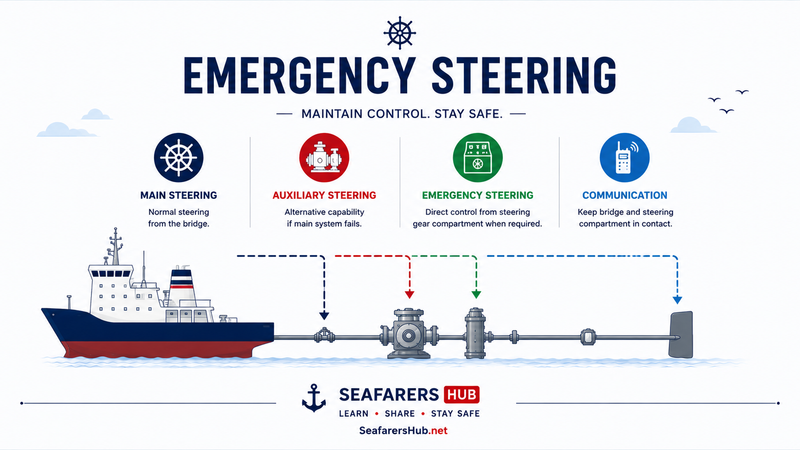
The expression emergency steering is commonly used for the arrangements and procedures that allow the crew to maintain or regain control of the ship when normal bridge steering becomes unavailable.
However, an important distinction should be made:
Emergency steering is not necessarily a completely separate “emergency steering gear.”
SOLAS principally defines requirements for the main steering gear and auxiliary steering gear, together with their control systems, power supplies, communications and other associated arrangements.
The main and auxiliary steering gear must be arranged so that failure of one does not render the other inoperative.
Main Steering Gear
The main steering gear provides the ship's normal means of steering.
Under SOLAS II-1/29, it must be capable of steering the ship at maximum ahead service speed.
For a conventional rudder arrangement, the main steering gear must be capable of moving the rudder:
35° on one side → 35° on the other side
and, under the specified SOLAS conditions:
35° on either side → 30° on the other side within 28 seconds.
The performance requirement is based on the ship being at its deepest seagoing draught and running ahead at maximum ahead service speed, subject to permitted alternative sea-trial arrangements where demonstrating compliance at that draught is impracticable.
Auxiliary Steering Gear
The auxiliary steering gear provides an alternative means of steering when the main steering gear cannot perform its function.
Under SOLAS II-1/29, it must be of adequate strength, capable of steering the ship at navigable speed and capable of being brought rapidly into operation during an emergency.
For conventional rudder steering, it must be capable of moving the rudder:
15° on one side → 15° on the other side within 60 seconds
with the ship at its deepest seagoing draught and running ahead at one-half maximum ahead service speed or 7 knots, whichever is greater, subject again to permitted alternative trial conditions.
Does Every Ship Have a Separate Auxiliary Steering Gear?
Not necessarily.
SOLAS permits certain arrangements where the main steering gear consists of two or more identical power units and a separate auxiliary steering gear need not be fitted, provided the applicable performance, redundancy and failure-isolation requirements are satisfied.
The precise requirements differ according to the ship and steering arrangement.
This is important because seafarers should not assume that every vessel has a physically separate piece of equipment labelled “Emergency Steering Gear.”
What Happens if Bridge Steering Fails?
A steering failure does not necessarily mean that the rudder itself or the steering gear machinery has failed.
The problem could involve the remote steering-control system, electrical supply, hydraulic system, steering gear power unit or another component.
Depending on the failure and the vessel's arrangement, steering may be transferred to another control system or carried out directly from the steering gear compartment.
A simplified emergency situation might therefore involve:
Bridge steering failure → establish communication → change steering/control arrangement → operate steering locally → maintain communication with the bridge
The actual procedure must always follow the vessel's approved steering arrangement and emergency procedures.
Communication With the Bridge
Communication is particularly important when steering is controlled locally.
Under SOLAS II-1/29, a means of communication must be provided between the navigation bridge and steering gear compartment.
During local emergency steering, the bridge can therefore communicate the required steering orders to personnel operating or controlling the steering gear.
SOLAS V/26 specifically requires this communication procedure to be practiced during emergency steering drills.
Rudder Angle Indication
Personnel controlling the ship need to know the actual rudder position.
SOLAS II-1/29 contains requirements concerning indication of the angular position of the rudder, while SOLAS V/26 requires the rudder-angle indicators to be checked against the actual rudder position during steering-gear testing.
This becomes particularly important during emergency steering because the bridge and steering gear compartment must maintain a common understanding of the rudder position.
Alternative Power Supply
Certain steering installations are required to have an alternative power supply.
Under SOLAS II-1/29, where the applicable conditions are met, alternative power sufficient to supply at least a steering gear power unit, its associated control system and the rudder-angle indicator must become available automatically from the emergency source of electrical power or another independent source.
For the arrangements to which this requirement applies, the alternative supply must become available automatically within 45 seconds.
The required operating period is:
at least 30 minutes for ships of 10,000 GT and above; and
at least 10 minutes for other applicable ships.
These requirements should not be interpreted as meaning that every steering installation on every ship has the same alternative-power arrangement.
Steering Gear Testing Before Departure
Emergency preparedness starts before the ship sails.
Under SOLAS V/26, the steering gear must generally be checked and tested by the crew within 12 hours before departure.
Where applicable, the test includes the main and auxiliary steering gear, remote control systems, bridge steering positions, emergency power supply, rudder-angle indicators, power-failure alarms, steering-gear power-unit failure alarms and automatic equipment.
The checks also include full rudder movement according to the steering gear's required capabilities, visual inspection of the steering gear and connecting linkage, and testing communication between the bridge and steering gear compartment.
SOLAS provides a limited alternative for ships regularly engaged on voyages of short duration where the Administration waives the normal requirement; in that case, the specified checks and tests must be conducted at least weekly.
Emergency Steering Drills
Under SOLAS V/26, emergency steering drills must be conducted at least once every three months.
The drills must include:
direct control from within the steering gear compartment;
communication procedures with the navigation bridge; and
where applicable, operation of alternative power supplies.
The date and details of the emergency steering drills must also be recorded.
Steering Changeover Instructions
SOLAS V/26 also requires simple operating instructions with a block diagram showing changeover procedures for remote steering-control systems and steering-gear power units.
These instructions must be permanently displayed on the navigation bridge and in the steering compartment.
Officers involved in operating or maintaining the steering gear must be familiar with the systems fitted and the procedures for changing from one system to another.
What Should Seafarers Know?
Knowing that the ship has an auxiliary steering arrangement is not enough. Personnel involved should understand the location of the steering gear compartment, local control arrangements, changeover procedure, communication system, power units, alternative power supply where fitted, rudder-angle indication and relevant alarms.
They should also know how to reach the steering gear compartment quickly and safely.
The actual arrangement varies considerably between vessels, so ship-specific familiarization is essential.
Common Emergency Steering Problems
Loss or degradation of steering can result from many different failures, including electrical power loss, remote-control failure, hydraulic leakage, steering pump or power-unit failure, control-system faults and other mechanical or electrical problems. The correct response depends on the actual failure and the steering system fitted on the vessel.
Final Thoughts
Emergency steering is not simply a backup steering wheel or a separate piece of machinery.
It is a combination of redundancy, alternative steering capability, control arrangements, power supply, communication, indication, testing and crew preparedness.
SOLAS II-1/29 establishes the principal technical requirements for steering gear, while SOLAS V/26 ensures that the equipment is tested and that crews regularly practice emergency steering.
For seafarers, three questions are especially important:
If bridge steering fails, do you know where to go? Do you know how to take local control? Can you communicate effectively with the bridge?
Knowing the answers before steering is lost can make a critical difference during an emergency.
International Maritime Organization (IMO). SOLAS Consolidated Edition 2024, Chapter V, Regulation 26 — Steering gear: testing and drills.
International Maritime Organization (IMO). Unified Interpretations of SOLAS Regulations II-1/29.3 and II-1/29.4.
International Maritime Organization (IMO). Unified Interpretations concerning steering capability and function for ships fitted with propulsion and steering arrangements other than traditional arrangements.