Emergency Generator on Ships: SOLAS Requirements and How It Works
Learn how a ship’s emergency generator provides essential electrical power during a blackout, including its operation, starting arrangements, and key SOLAS requirements.
SeafarersHub Editorial Team••7 min read
Share
Emergency Generator on Ships: SOLAS Requirements and How It Works
A blackout at sea can immediately affect lighting, communications, navigation equipment, alarms, pumps and other essential services.
The emergency generator is therefore one of the most important safety systems on a ship. It provides an independent source of electrical power when the main electrical supply is lost, allowing specified emergency services to remain available.
This article explains the purpose, arrangement and operation of the emergency generator and the principal requirements of SOLAS Chapter II-1.
An emergency generator is an independent generating set forming part of the ship's emergency electrical power system.
Its purpose is not to restore normal operation of the entire ship. Instead, it supplies electrical power to specified services essential for safety when the main electrical power supply fails.
SOLAS addresses emergency electrical power principally under:
SOLAS II-1/42 — Emergency source of electrical power in passenger ships;
SOLAS II-1/43 — Emergency source of electrical power in cargo ships; and
SOLAS II-1/44 — Starting arrangements for emergency generating sets.
It is important to note that SOLAS does not require the emergency source to be a generator in every permitted arrangement. Depending on the applicable regulation, the emergency source may be a generator or an accumulator battery.
Why Must the Emergency Generator Be Independent?
An emergency source would provide little protection if the same casualty that disabled the main generators also disabled the emergency generator.
SOLAS therefore requires the emergency source of electrical power, associated transforming equipment, transitional source where required, emergency switchboard and emergency lighting switchboard to be located so that a fire or other casualty affecting the main electrical source and associated equipment will not interfere with the emergency supply.
For cargo ships, these principles are addressed in SOLAS II-1/43.
This is why emergency generators are normally located away from the main machinery spaces and main source of electrical power.
What Happens During a Blackout?
In a typical arrangement, loss of the main electrical supply initiates the emergency power sequence.
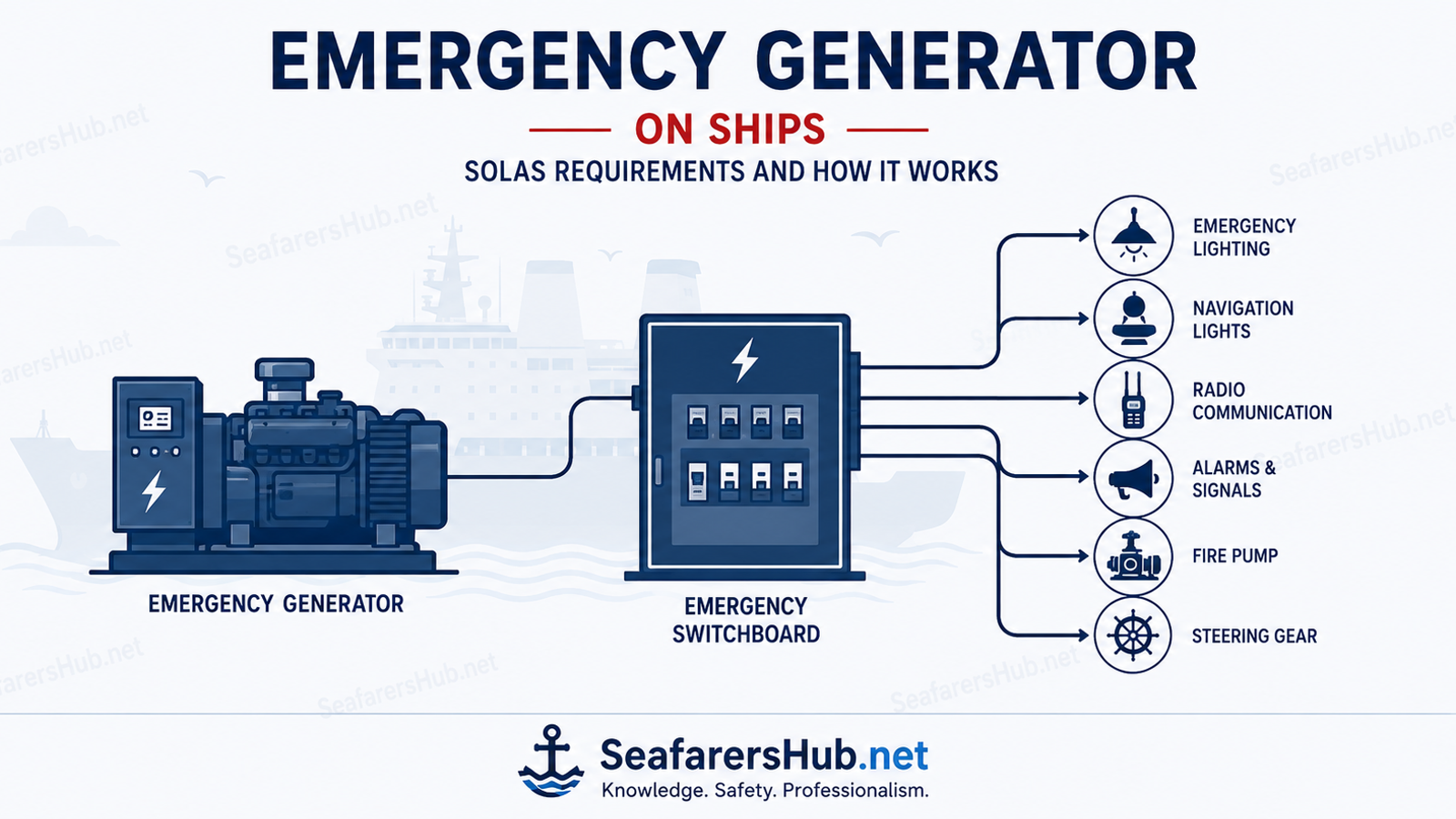
The emergency generator starts, reaches suitable operating conditions and supplies the emergency switchboard, which then distributes power to the required emergency consumers.
However, the exact sequence depends on the vessel's approved electrical arrangement.
A useful simplified sequence is:
Main power failure → emergency source becomes available → emergency switchboard energized → required emergency services supplied
The emergency generator should therefore not be viewed alone. It works together with the emergency switchboard, starting system, protection system and emergency consumers.
What Does the Emergency Generator Supply?
SOLAS specifies which services must be supplied from the emergency source and for how long.
For cargo ships under SOLAS II-1/43, these can include, as applicable:
emergency lighting;
navigation lights;
radio installations;
internal communication equipment required during an emergency;
specified navigational equipment;
fire detection and fire alarm systems;
manually operated call points and internal emergency signals;
a required fire pump when dependent on emergency electrical power; and
steering gear where emergency electrical supply is required by SOLAS.
emergency air compressor.
Not every emergency consumer operates for the same period, and requirements differ between cargo and passenger ships.
Therefore, statements such as “the emergency generator must supply the ship for 18 hours” are too general.
How Long Must Emergency Power Be Available?
For cargo ships, SOLAS II-1/43 specifies different durations depending on the emergency service.
For example, emergency lighting at every muster and embarkation station is required for 3 hours, while many other specified emergency services are required for 18 hours.
Passenger ships are governed principally by SOLAS II-1/42, where different requirements apply and many specified services require emergency supply for 36 hours.
The correct duration must therefore always be determined from the applicable regulation and service.
Does the Emergency Generator Have to Start Within 45 Seconds?
This is one of the most commonly quoted emergency-generator requirements and one that should be stated carefully.
It is not accurate simply to say:
“SOLAS requires every emergency generator to start within 45 seconds.”
For cargo ships, SOLAS II-1/43 permits an arrangement in which the emergency generator can serve in place of a transitional source of emergency electrical power when it can start automatically and supply the required load as quickly as is safe and practicable, subject to a maximum of 45 seconds.
The requirement therefore needs to be understood in the context of the particular emergency electrical arrangement.
How Is the Emergency Generator Started?
Starting arrangements are addressed by SOLAS II-1/44.
Emergency generating sets must be capable of being readily started in their cold condition at the specified temperature.
SOLAS also requires stored energy sufficient for the required number of consecutive starts.
Depending on the installation, starting may use:
compressed air;
electrical starting systems; or
another approved starting arrangement.
Where compressed air is used, the starting-air supply may be maintained from main or auxiliary air receivers through an appropriate non-return arrangement or by an emergency air compressor.
If that emergency air compressor is electrically driven, it is supplied from the emergency switchboard.
Emergency Generator vs Emergency Switchboard
These two terms should not be confused.
The emergency generator produces electrical power.
The emergency switchboard receives emergency electrical power and distributes it to the required emergency services.
SOLAS defines the emergency switchboard as the switchboard which, following failure of the main electrical supply, is supplied directly by the emergency or transitional source and distributes electrical energy to emergency services.
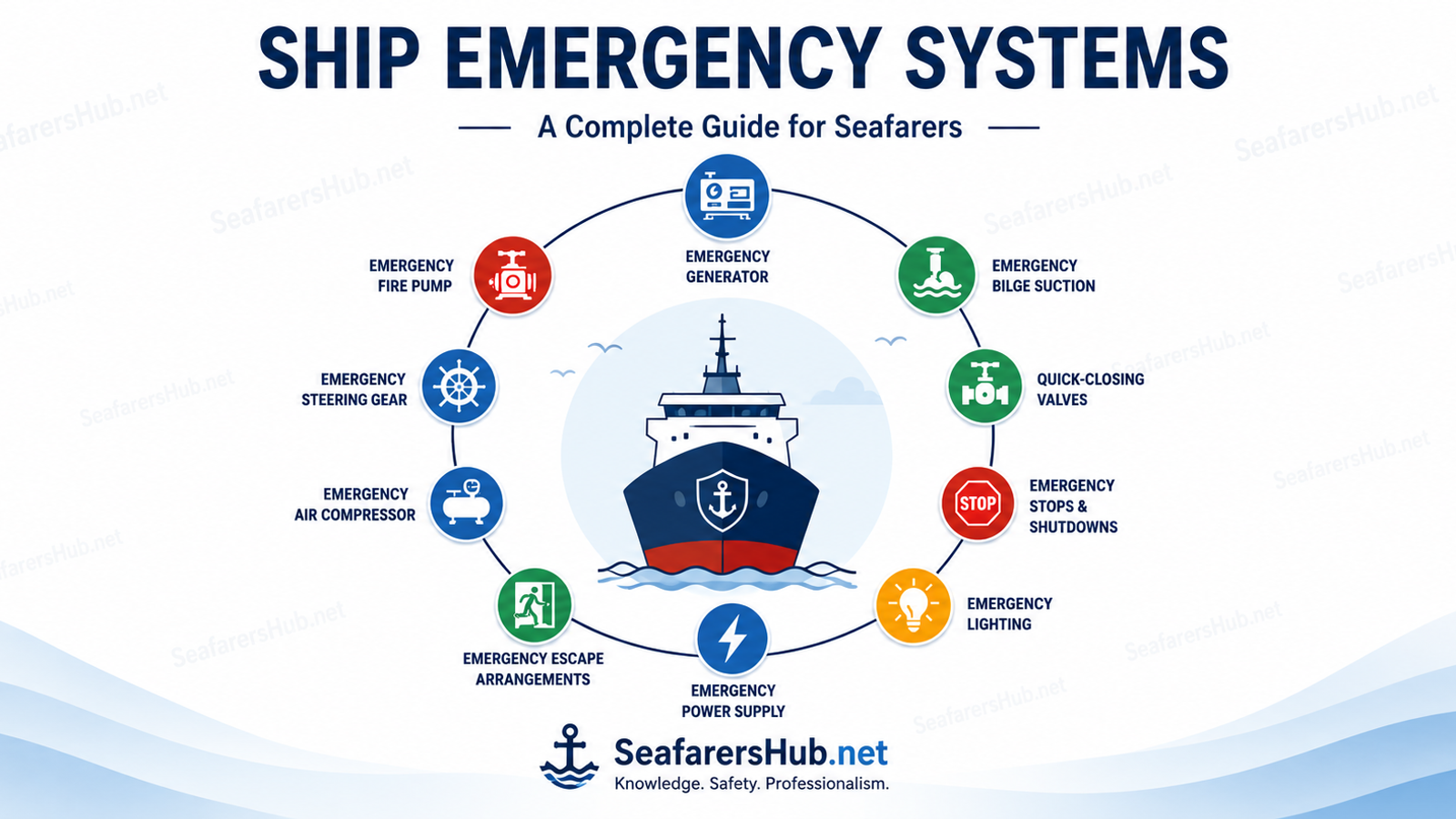
The emergency electrical system will be covered separately later in this series.
Testing the Emergency Generator
An emergency generator that cannot start when required provides little protection during a blackout.
Regular testing is therefore essential.
Shipboard testing normally verifies matters such as:
starting capability;
starting batteries or starting-air condition;
fuel and lubricating-oil condition;
cooling arrangements;
automatic starting where fitted;
voltage and frequency;
connection to the emergency switchboard;
alarms and indications; and
general condition of the generating set.
Testing must follow the vessel's approved procedures, manufacturer's instructions, planned maintenance system and applicable statutory requirements.
Crew members should avoid assuming that the testing procedure is identical on every ship.
What Should Seafarers Check?
Personnel responsible for the emergency generator should be familiar with its location and operating arrangement.
Particular attention should be given to the condition of the starting system, fuel supply, lubricating oil, cooling arrangement, batteries or starting-air system, control mode, breakers and emergency switchboard.
Any abnormal alarm, leakage, low battery condition, starting failure or incorrect selector-switch position should be investigated promptly.
The objective is simple: the emergency generator must be ready before the emergency occurs.
Common Emergency Generator Problems
Problems that may prevent successful emergency-generator operation include:
discharged starting batteries;
insufficient starting air;
starting-system faults;
fuel supply problems;
incorrect control-selector position;
breaker or electrical protection problems;
cooling or lubrication faults; and
inadequate maintenance or testing.
These are practical examples rather than a SOLAS list of prescribed failure modes. The actual installation and manufacturer's instructions should always be consulted.
Final Thoughts
The emergency generator is a critical part of a ship's emergency electrical system.
Its purpose is not to power the entire vessel after a blackout, but to ensure that specified safety-critical services remain available when the main electrical supply fails.
SOLAS Chapter II-1 establishes requirements for the emergency source, its independence, the services it supplies, required operating periods and the starting arrangements for emergency generating sets.
For seafarers, the most important questions are practical:
Will it start? Will it connect? And will it supply the equipment needed during the emergency?
Regular testing, maintenance and familiarization help ensure that the answer to all three is yes.
References
International Maritime Organization (IMO). SOLAS Consolidated Edition 2024, Chapter II-1, Regulations 42, 43 and 44.
International Maritime Organization (IMO). January 2026 Supplement – SOLAS Consolidated Edition 2024. The official supplement lists the amendments entering into force on 1 January 2026.