A professional examination of COLREG Rule 5, explaining how sight, hearing, radar and other available means must be combined to maintain situational awareness and detect collision risk early.
SeafarersHub Editorial Team••9 min read
Share
COLREG Rule 5 is one of the shortest rules in the International Regulations for Preventing Collisions at Sea, yet it is fundamental to almost every collision-avoidance decision made on the bridge.
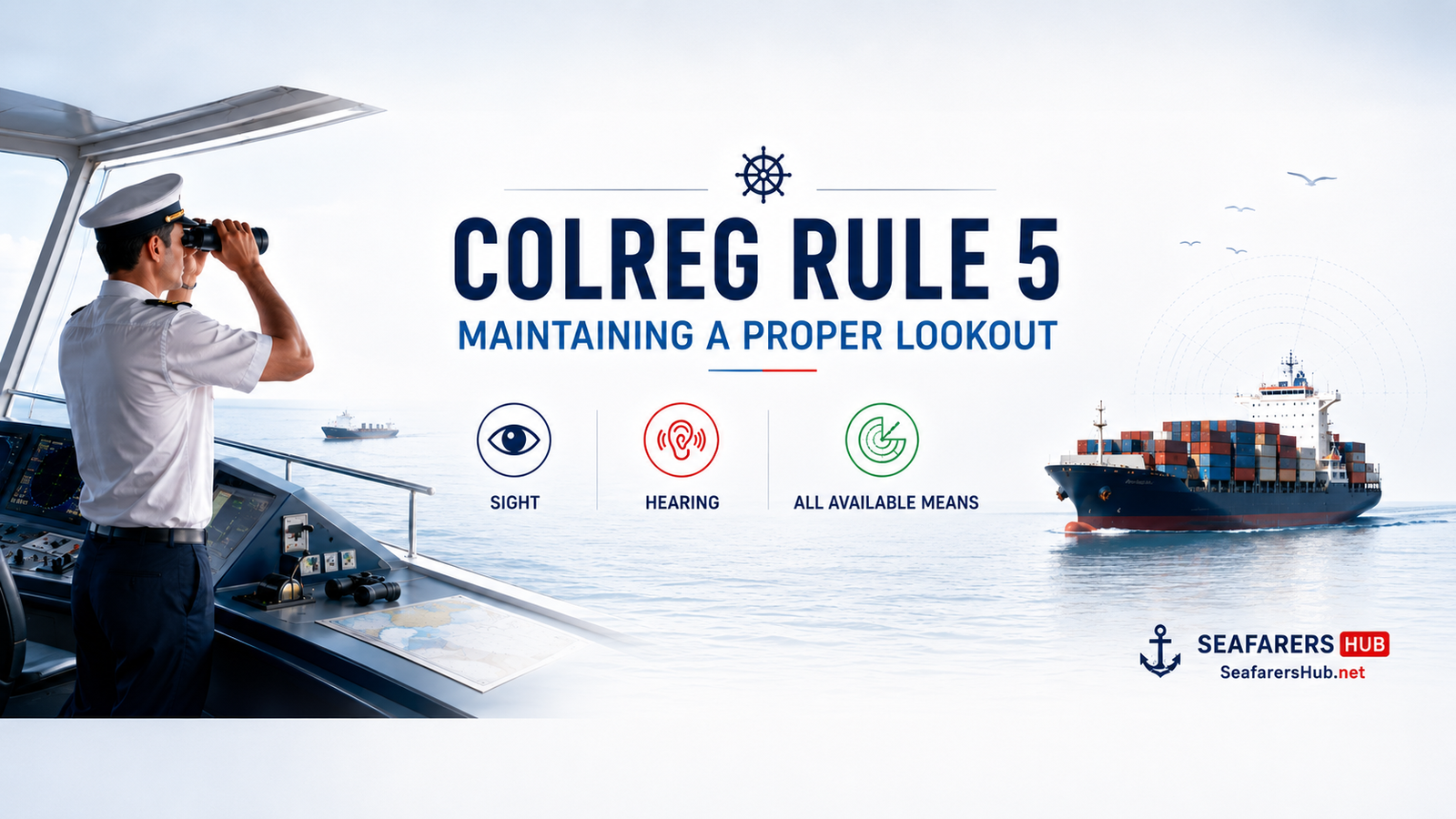
The Rule requires every vessel, at all times, to maintain a proper lookout using sight, hearing and all available means appropriate to the prevailing circumstances and conditions. The objective is not merely to detect other vessels, but to develop a sufficiently complete understanding of the situation and identify collision risk early enough for effective action. Rule 4 makes clear that this requirement applies in any condition of visibility.
For the professional navigator, Rule 5 is therefore not simply an instruction to “look outside.” It is a continuous process of observation, detection, interpretation and verification.
What Does “Proper Lookout” Actually Mean?
A proper lookout must enable the bridge team to understand what is happening around the vessel and what may develop next.
The STCW Code expands this principle. It states that lookout should maintain continuous vigilance, support appraisal of collision, stranding and other navigational risks, and allow detection of ships or aircraft in distress, wrecks, debris and other hazards.
This makes lookout broader than collision avoidance alone.
A lookout should therefore be capable of detecting:
vessels approaching from any relevant direction,
navigation lights and shapes,
changes in vessel aspect,
sound signals,
fishing activity,
small craft,
floating objects,
navigation marks,
persons or vessels in distress,
deteriorating visibility,
and other changes affecting safe navigation.
The key professional question is not simply:
“Can I see another ship?”
It is:
“Do I understand the developing situation well enough to identify the risk?”
Lookout by Sight
Visual observation remains one of the primary requirements of Rule 5.
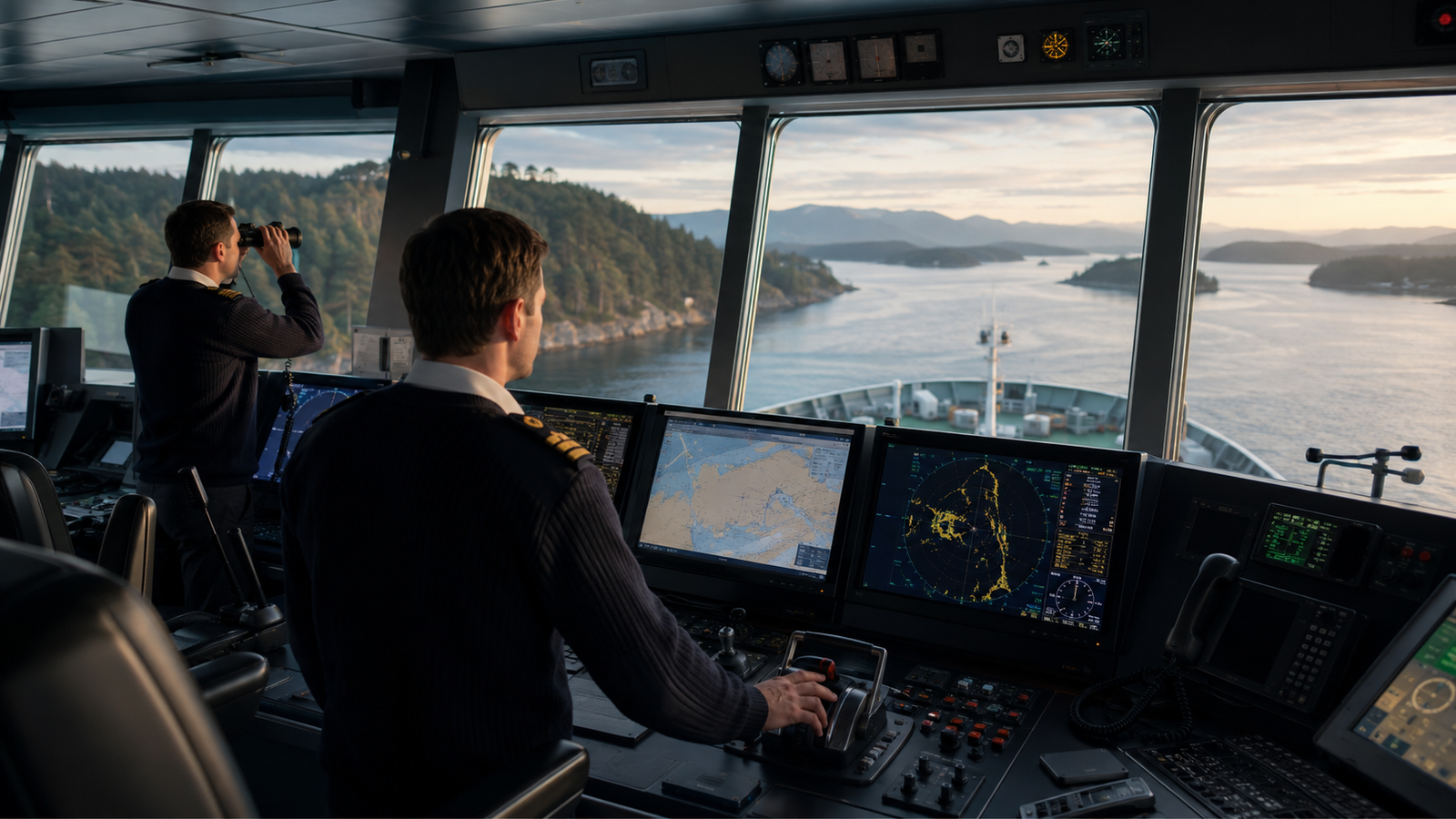
A professional visual lookout should be systematic rather than casual. Scanning should cover the full navigational environment, including sectors not immediately ahead of the vessel.
Visual information can provide details that electronic systems may not immediately reveal, such as:
the aspect of another vessel,
whether navigation lights are correctly displayed,
fishing gear or operations,
small craft not producing a strong radar echo,
floating debris,
changes in visibility,
and visual indications that another vessel is altering course.
Repeated visual bearings also help the OOW determine how another vessel is moving relative to own ship.
STCW specifically requires officers in clear weather to take frequent and accurate compass bearings of approaching vessels to support early detection of collision risk. It also warns that risk may still exist even when some bearing change is observed, particularly with very large ships, tows or vessels at close range.
This is why Rule 5 and Rule 7 — Risk of Collision should always be understood together.
Lookout by Hearing
Hearing is sometimes underestimated on modern bridges.
Rule 5 specifically requires lookout by hearing because sound may provide information before a vessel or hazard is visually identified.
Examples include:
fog signals,
whistle signals,
another vessel’s engines,
alarms,
distress calls,
pilot or tug communications,
and unusual sounds from outside the vessel.
During restricted visibility, sound signals may become particularly important.
A bridge with doors closed, excessive conversation, loud entertainment, unnecessary alarms or poor bridge discipline can reduce the effectiveness of auditory lookout.
The professional lookout must therefore remain able to hear and interpret relevant external sounds.
“All Available Means” — What Does It Include?
Rule 5 deliberately goes beyond sight and hearing.
On a modern merchant ship, “all available means” may include:
marine radar,
ARPA,
AIS,
ECDIS,
GNSS information,
VHF traffic information,
VTS reports,
visual bearings,
compass information,
and other appropriate navigational sensors.
Radar is particularly important because it supports detection and tracking of surface craft, navigational objects and shorelines. IMO performance standards specifically describe radar as an aid to safe navigation and collision avoidance and recognize its role in improving situational awareness.
However, electronic information must be interpreted carefully.
Radar may be affected by:
sea clutter,
rain clutter,
shadow sectors,
weak target echoes,
incorrect tuning,
inappropriate range scales,
target loss,
or tracking errors.
STCW therefore requires radar users to appreciate its limitations and, in congested waters or restricted visibility, to use appropriate range scales and systematic analysis so that targets are detected early.
AIS Is Helpful — But Not a Lookout Replacement
AIS can improve target identification and situational awareness, but it should never replace visual observation or radar assessment.
AIS information may depend on manually entered data and may not accurately represent another vessel’s present intentions. Not every vessel or object will necessarily be represented.
A useful bridge principle is:
Visual information + radar/ARPA + AIS + navigational context should support one another, not substitute for one another.
If the sources disagree, the disagreement itself should be treated as information requiring investigation.
Lookout and Officer of the Watch Are Not Always the Same Person
One important STCW distinction is that the lookout must be able to give full attention to lookout duties and should not be assigned tasks that interfere with that responsibility.
The helmsman and lookout are normally separate duties. STCW only allows limited exceptions for small ships where the steering position provides an unobstructed view and there is no impairment to effective lookout.
The OOW may act as the sole lookout during daylight, but this is not an automatic permission.
Before doing so, the situation must be assessed and it must be established that it is safe. Relevant considerations include:
weather,
visibility,
traffic density,
proximity of navigational hazards,
traffic separation schemes,
and the immediate availability of assistance.
Therefore, “daylight” by itself is not sufficient justification for operating without a separate lookout.
Watch Composition Must Change with the Situation
The bridge watch should not remain fixed regardless of conditions.
STCW requires the Master to consider factors including visibility, sea state, traffic density, routeing systems, workload, competence of personnel, bridge configuration, equipment status, vessel maneuverability and the availability of additional assistance when determining whether the watch is adequate.
This has an important operational consequence:
A watch arrangement that is acceptable in clear open water may become inadequate when the ship approaches:
a Traffic Separation Scheme,
a pilot station,
a narrow channel,
dense fishing traffic,
heavy weather,
restricted visibility,
or a congested port approach.
The bridge team should increase resources before situational complexity exceeds the capability of the existing watch.
Restricted Visibility Requires a Stronger Lookout
Restricted visibility is one of the situations where Rule 5 becomes particularly critical.
STCW requires that when restricted visibility is encountered or expected, the OOW:
informs the Master,
posts a proper lookout,
displays the appropriate navigation lights,
operates and uses radar,
and complies with the relevant COLREG requirements.
The phrase “encountered or expected” is important.
The bridge team should not wait until visibility has deteriorated severely before strengthening the watch.
Preparation should occur while the risk is developing.
Lookout Must Be Continuous
A proper lookout cannot be maintained intermittently.
STCW states that the OOW must ensure a proper lookout is maintained at all times and should not undertake tasks that interfere with safe navigation.
Typical distractions can include:
paperwork,
emails,
arrival documentation,
administrative checklists,
prolonged radio conversations,
personal mobile devices,
or excessive attention to one navigation display.
This creates an important distinction between looking at equipment and maintaining lookout.
An OOW who spends several minutes concentrating exclusively on ECDIS may technically be working on navigation while simultaneously losing awareness of the external environment.
Lookout therefore requires continuous movement of attention between:
rather than prolonged fixation on a single source.
The Lookout Should Anticipate, Not Only Observe
The best lookout is forward-looking.
If a vessel is detected at long range, the objective is not merely to note its existence. The bridge team should immediately begin asking:
What is its relative movement?
Is its bearing changing?
What is the expected CPA?
Could another target affect the encounter?
Is our vessel approaching a narrow channel or TSS?
Could visibility deteriorate?
Is there enough sea room for an avoiding maneuver?
Will speed need to be reduced?
This converts lookout into situational awareness.
The sequence becomes:
Detect → Identify → Track → Assess → Anticipate
The next stage—deciding whether collision risk exists—belongs primarily to COLREG Rule 7, while the resulting maneuver is governed principally by Rule 8 and the applicable steering and sailing rules.
Casualty Lessons: Why Rule 5 Still Matters
IMO casualty lessons continue to identify poor lookout as a factor in collisions.
In one IMO-published case involving a collision between a liquefied gas carrier and a local tug, the investigation found shortcomings in navigation duties and emphasized the need to comply with Rule 5, monitor traffic conditions properly and maintain effective lookout during transit.
The lesson is significant because modern ships already carry extensive electronic navigation equipment.
The problem is therefore rarely simply the absence of information.
More often, information exists but is:
not detected,
not interpreted,
not shared,
or not acted upon early enough.
A Practical Lookout Cycle
For operational use, Rule 5 can be remembered through five steps:
1. Observe
Use sight and hearing continuously.
2. Detect
Identify vessels, hazards and changes early.
3. Verify
Cross-check visual information with radar, AIS and other available means.
4. Assess
Determine whether the situation or collision risk is developing.
5. Escalate
Call additional bridge personnel or the Master before the situation becomes critical.
This cycle should continue throughout the watch.
Professional Takeaway
COLREG Rule 5 is the foundation upon which many later collision-avoidance decisions depend.
Without effective lookout:
Rule 6 cannot be applied intelligently because the navigator may not appreciate the conditions determining safe speed.
Rule 7 cannot be applied properly because collision risk may not be detected.
Rule 8 may be applied too late because the situation was recognized too late.
A proper lookout therefore means far more than seeing another vessel.
It means maintaining an accurate and continuously updated picture of the navigational environment using:
Sight + Hearing + Electronic Information + Professional Judgment
The strongest operational principle is:
See early. Understand early. Act before the situation becomes urgent.
References
International Maritime Organization. (1972). Convention on the International Regulations for Preventing Collisions at Sea, 1972 (COLREG), as amended. International Maritime Organization.
International Maritime Organization. (2004). Adoption of the revised performance standards for radar equipment (Resolution MSC.192(79)). International Maritime Organization.
International Maritime Organization. (2010). Adoption of amendments to the Seafarers’ Training, Certification and Watchkeeping Code (STCW/CONF.2/34). International Maritime Organization.
International Maritime Organization. (2025). Lessons learned from marine casualties (III.3/Circ.14). International Maritime Organization.