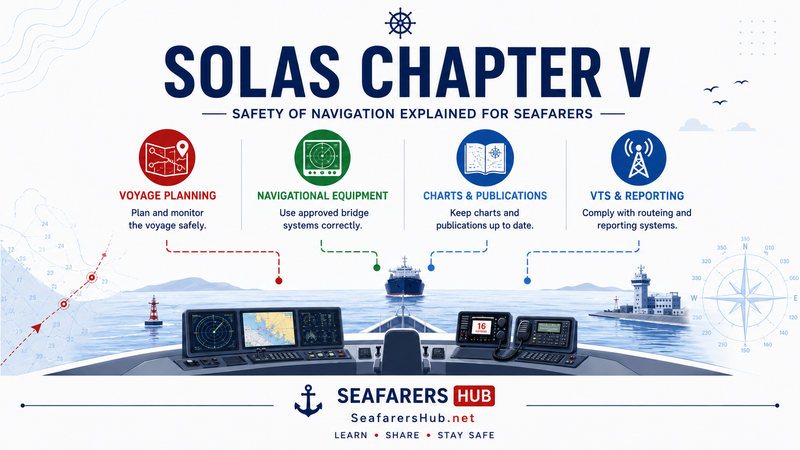
SOLAS Chapter V — Safety of Navigation is one of the most operationally important parts of the International Convention for the Safety of Life at Sea. Unlike many SOLAS provisions that apply mainly to specified ships on international voyages, Chapter V contains requirements that generally apply to all ships on all voyages, subject to stated exceptions.
For bridge teams, Chapter V connects voyage planning, navigational equipment, charts, reporting systems, VTS, pilot transfer, distress obligations and the Master’s authority into a single navigational safety framework.
More Than Bridge Equipment
A common mistake is to associate SOLAS Chapter V mainly with equipment such as ECDIS, radar, AIS or VDR. Equipment carriage is only one part of the chapter.
Chapter V also addresses services and operational responsibilities including:
- Meteorological services
- Search and rescue
- Hydrographic services
- Ships’ routeing
- Ship-reporting systems
- Vessel Traffic Services
- Safe manning
- Navigational equipment
- Pilot-transfer arrangements
- Nautical charts and publications
- Recording navigational activities
- Danger messages
- Assistance to persons in distress
- Voyage planning
This means compliance cannot be demonstrated simply by showing that the required equipment is installed.
Voyage Planning — Regulation 34
One of the most important operational provisions is SOLAS V/34 — Safe navigation and avoidance of dangerous situations.
Before proceeding to sea, the Master must ensure that the intended voyage has been planned using appropriate nautical charts and publications while considering IMO guidance. In practice, this produces the berth-to-berth passage plan.
A professional passage plan must go beyond drawing a route on ECDIS. It should address hazards, available water depth, under-keel clearance, tides, weather, routeing measures, reporting requirements, safe speeds, pilotage and contingency actions.
Execution does not end the planning process. The bridge team must continuously monitor the ship against the approved plan and respond when actual conditions differ from those anticipated.