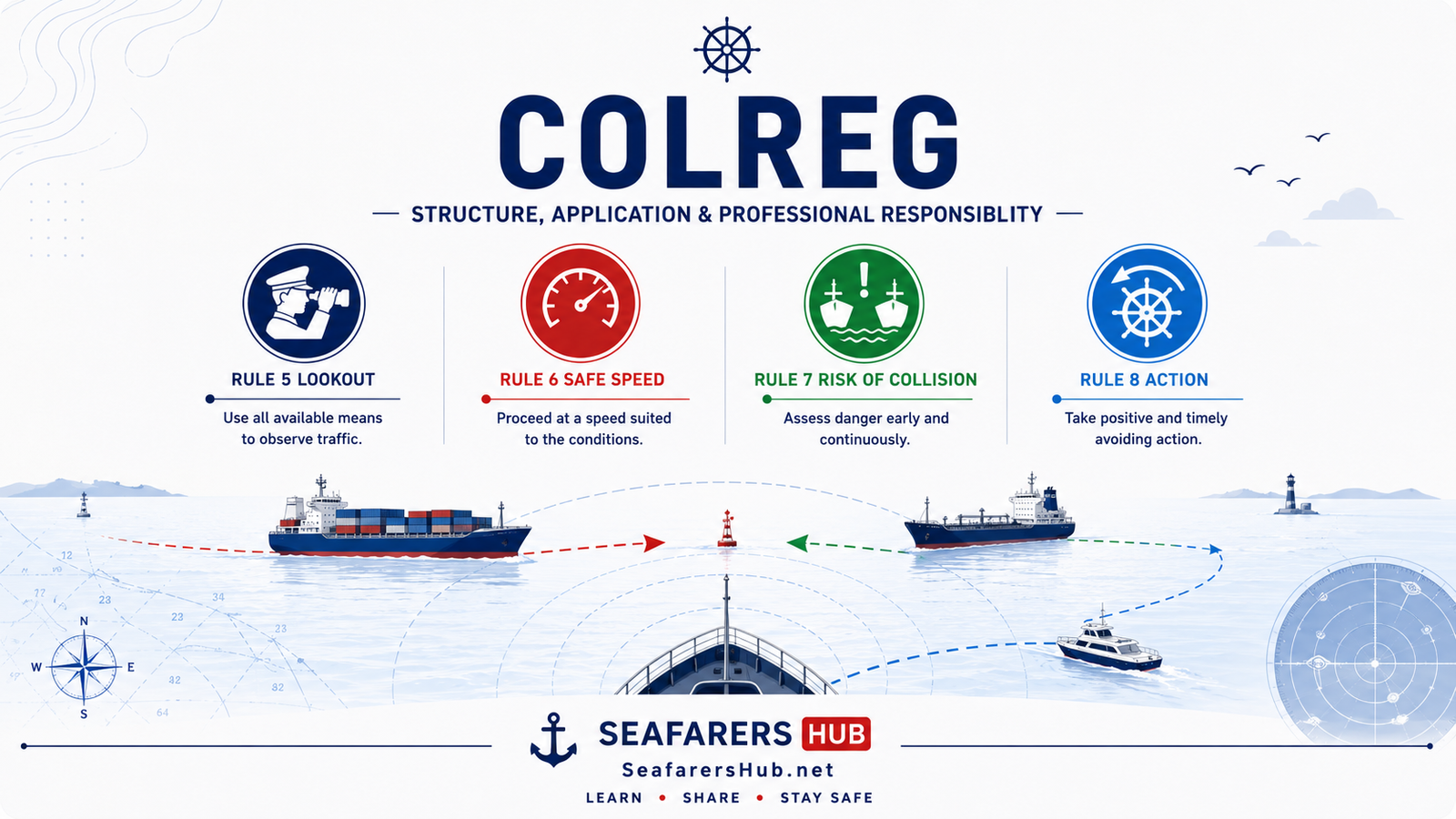
The Convention on the International Regulations for Preventing Collisions at Sea, 1972 (COLREG) is the primary international framework governing collision avoidance between vessels. Adopted in 1972 and in force since 15 July 1977, COLREG contains 41 Rules divided into six Parts, supported by four technical Annexes.
For professional navigators, knowing individual rules is not enough. Safe application requires identifying which rules govern the developing situation, using all available information, acting early enough to be understood by other vessels, and continuously checking whether the action taken is actually working.
How COLREG Is Structured
The Rules are organized into six Parts.
Part A — General, Rules 1–3
Application, responsibility and definitions.
Part B — Steering and Sailing, Rules 4–19
Lookout, safe speed, risk of collision, avoiding action, narrow channels, traffic separation schemes and vessel-to-vessel encounters.
Part C — Lights and Shapes, Rules 20–31
Identification of vessels by type, condition and activity.
Part D — Sound and Light Signals, Rules 32–37
Manoeuvring, warning, restricted-visibility and distress signals.
Part E — Exemptions, Rule 38
Part F — Verification of Compliance, Rules 39–41
Four Annexes provide technical requirements for lights and shapes, fishing signals, sound-signalling appliances and distress signals.
Rule 2 — Professional Responsibility
Rule 2 is fundamental because COLREG is not designed as a mechanical checklist.
It places responsibility on the vessel, owner, Master and crew for compliance while recognizing precautions required by the ordinary practice of seamen and by the particular circumstances of a situation. It also recognizes that special circumstances, including limitations of the vessels involved, may make departure from the Rules necessary to avoid immediate danger.
This does not provide permission to disregard COLREG whenever an officer prefers another manoeuvre. Any departure must be justified by the immediate danger and circumstances.
Professional judgement therefore works within COLREG, not instead of it.