
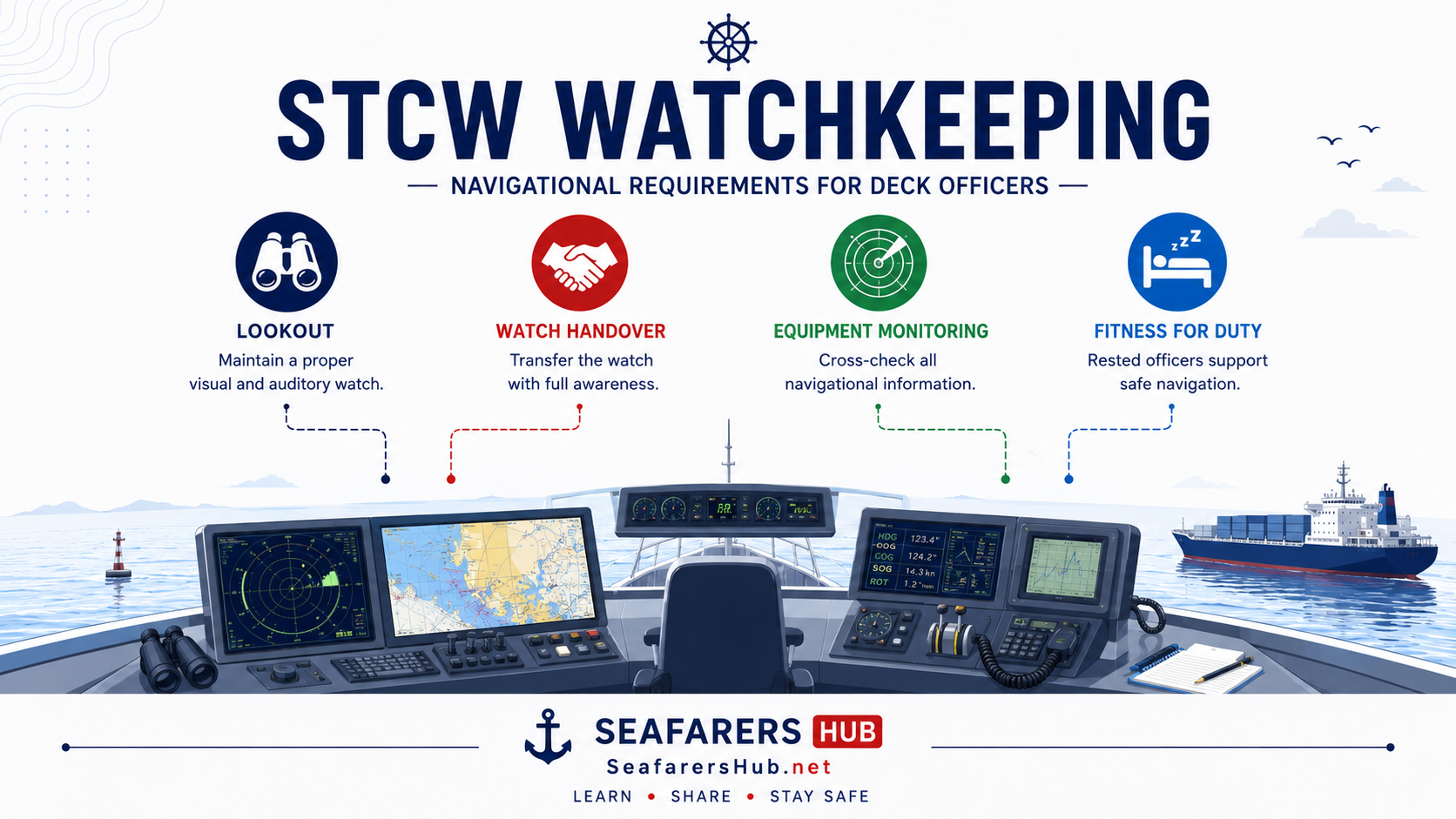
The STCW Convention and Code establish the international competence and watchkeeping standards for seafarers. For deck officers, Chapter II addresses certification and competence, while Chapter VIII—Watchkeeping, supported by Sections A-VIII/1 and A-VIII/2 of the STCW Code, establishes requirements for fitness for duty and safe watchkeeping arrangements.
Part A of the STCW Code is mandatory; Part B provides recommended guidance. For an Officer of the Watch (OOW), these requirements transform certification into practical responsibility on the bridge.
The OOW as the Master’s Representative
During a navigational watch, the OOW acts as the Master’s representative and has primary responsibility for the safe navigation of the ship and compliance with the applicable collision-prevention rules.
An important principle is often misunderstood: the Master simply arriving on the bridge does not automatically transfer responsibility from the OOW. Responsibility changes only when the Master clearly states that they have assumed it and both understand that the transfer has occurred.
The OOW must also avoid taking on duties that interfere with safe navigation.
Maintaining a Proper Lookout
A safe navigational watch requires continuous awareness of the ship and its surroundings.
The lookout must use:
- Sight
- Hearing
- Radar and other available means
- Traffic and navigational information
- Changes in weather and visibility
The objective is not merely to identify other vessels. The watch must detect developing collision risk, grounding risk, navigational hazards, persons or vessels in distress, wrecks and other dangers.
Watch composition must therefore reflect traffic density, visibility, weather, proximity to hazards, bridge configuration, equipment status and the availability of additional personnel.
The bridge must never be left without an effective navigational watch.
Taking Over the Watch
Watch handover is a safety-critical operation rather than a routine exchange between officers.
A relieving officer should establish the vessel’s: