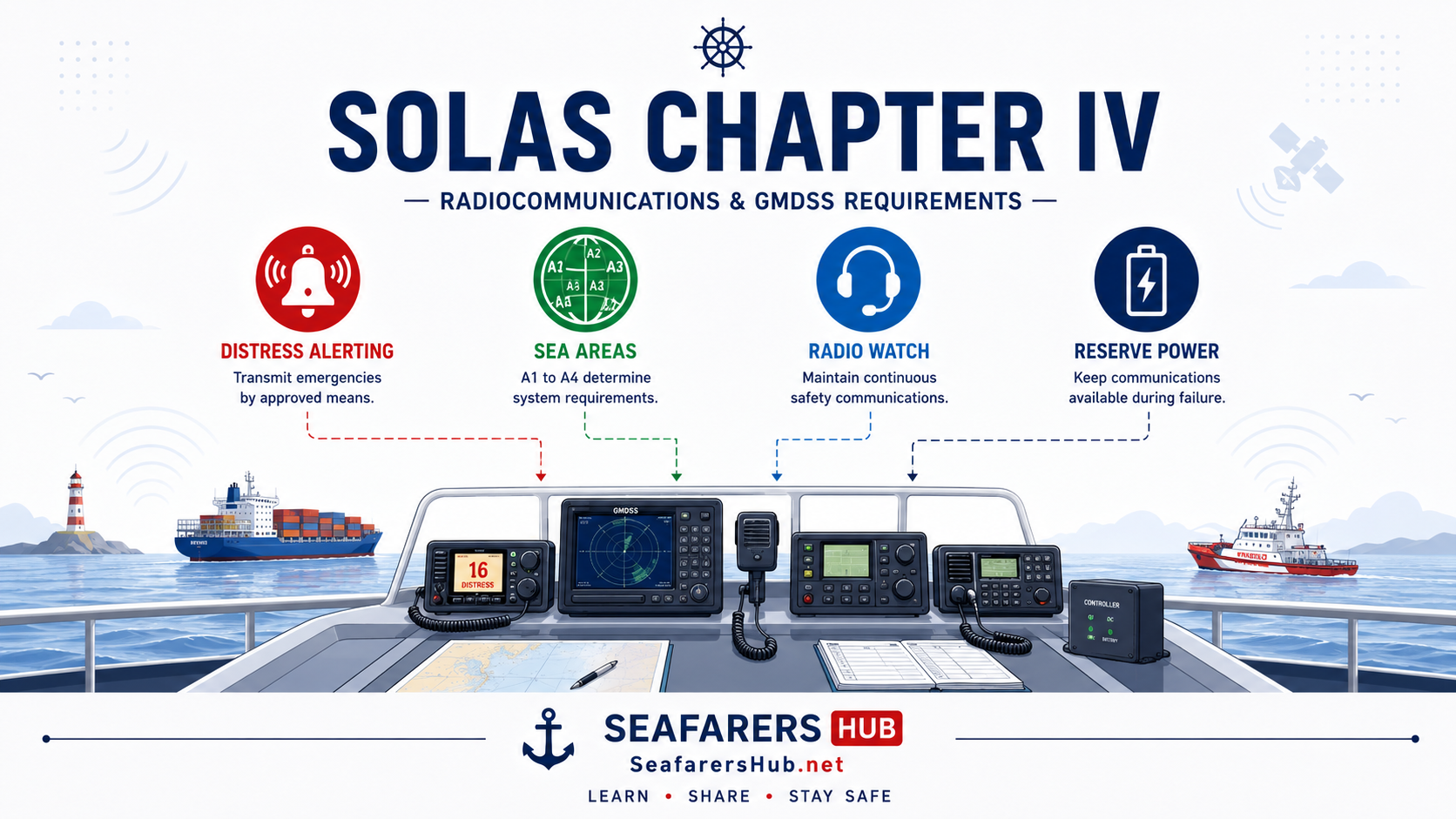
SOLAS Chapter IV — Radiocommunications provides the regulatory foundation for the Global Maritime Distress and Safety System (GMDSS). Its purpose is not simply to require ships to carry radios; it ensures that a ship at sea can transmit and receive distress alerts, communicate during search-and-rescue operations, receive Maritime Safety Information (MSI), and maintain essential safety communications.
The chapter principally applies to passenger ships and cargo ships of 300 gross tonnage and above on international voyages, subject to specific exemptions and exceptions.
GMDSS Is Based on Functions, Not Equipment
A professional understanding of GMDSS should start with SOLAS IV/4 — Functional Requirements.
While at sea, an applicable ship must be capable of performing essential communications functions, including:
- Ship-to-shore distress alerting
- Receiving shore-to-ship distress alerts
- Ship-to-ship distress communications
- Search-and-rescue coordination
- On-scene communications
- Transmission and reception of locating signals
- Reception of Maritime Safety Information
- Urgency and safety communications
- Bridge-to-bridge safety communications
Importantly, SOLAS requires ship-to-shore distress alerting by at least two separate and independent means using different radiocommunication services.
This redundancy is one of the fundamental safety principles behind GMDSS.
Sea Areas Determine the Radio Installation
GMDSS equipment is largely determined by where the vessel operates.
Sea Area A1 is within VHF coverage of a coast station providing continuous DSC alerting.
Sea Area A2 extends beyond A1 but remains within MF coast-station DSC coverage.
Sea Area A3 lies outside A1 and A2 but within coverage of a recognized mobile satellite service supported by the ship’s installed ship earth station.
Sea Area A4 covers waters outside A1, A2 and A3.
Therefore, a ship certified only for A1 operations does not require the same radio installation as a vessel trading in A4.