Emergency Fire Pump on Ships: SOLAS Requirements and How It Works
Fire at sea can quickly become a major emergency, particularly when it occurs in the machinery space. If a fire disables the main fire pumps or their power supply, the ship must still have a means of delivering water to the fire main.
This is the purpose of the emergency fire pump.
The emergency fire pump provides an independent source of firefighting water when the normal fire-pumping arrangement becomes unavailable. Its principal requirements are contained in SOLAS Chapter II-2, Regulation 10 – Firefighting, together with the technical requirements of Chapter 12 of the Fire Safety Systems (FSS) Code. SOLAS II-2/10 is specifically concerned with suppressing and rapidly extinguishing fire in the space of origin.
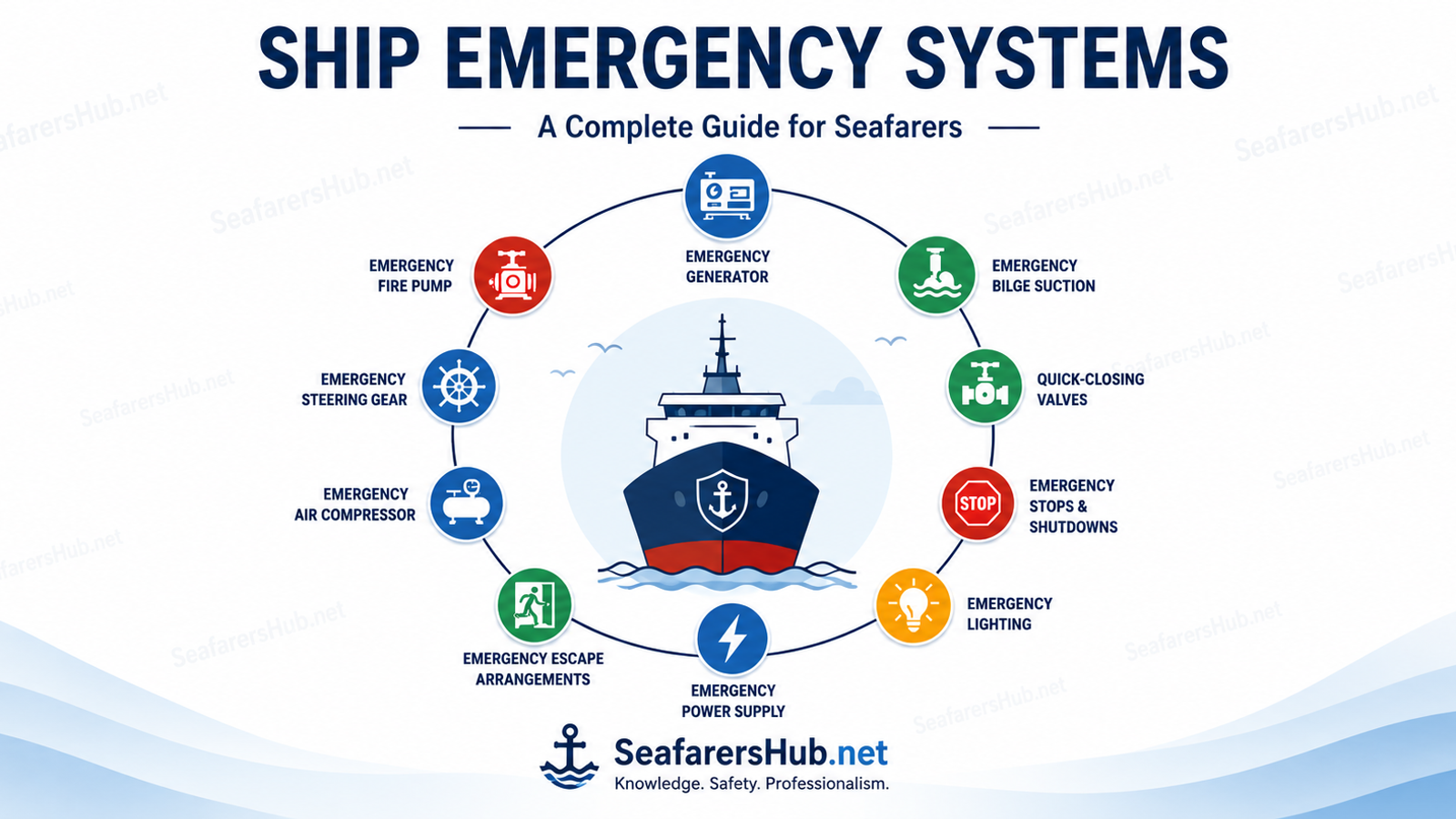
Learn more: Ship Emergency Systems: A Complete Guide for Seafarers | SeafarersHub
Regulatory basis: This article uses the SOLAS Consolidated Edition 2024 as its primary source, together with applicable IMO supplements and amendments. Exact SOLAS regulations are identified where regulatory requirements are discussed.
What Is an Emergency Fire Pump?
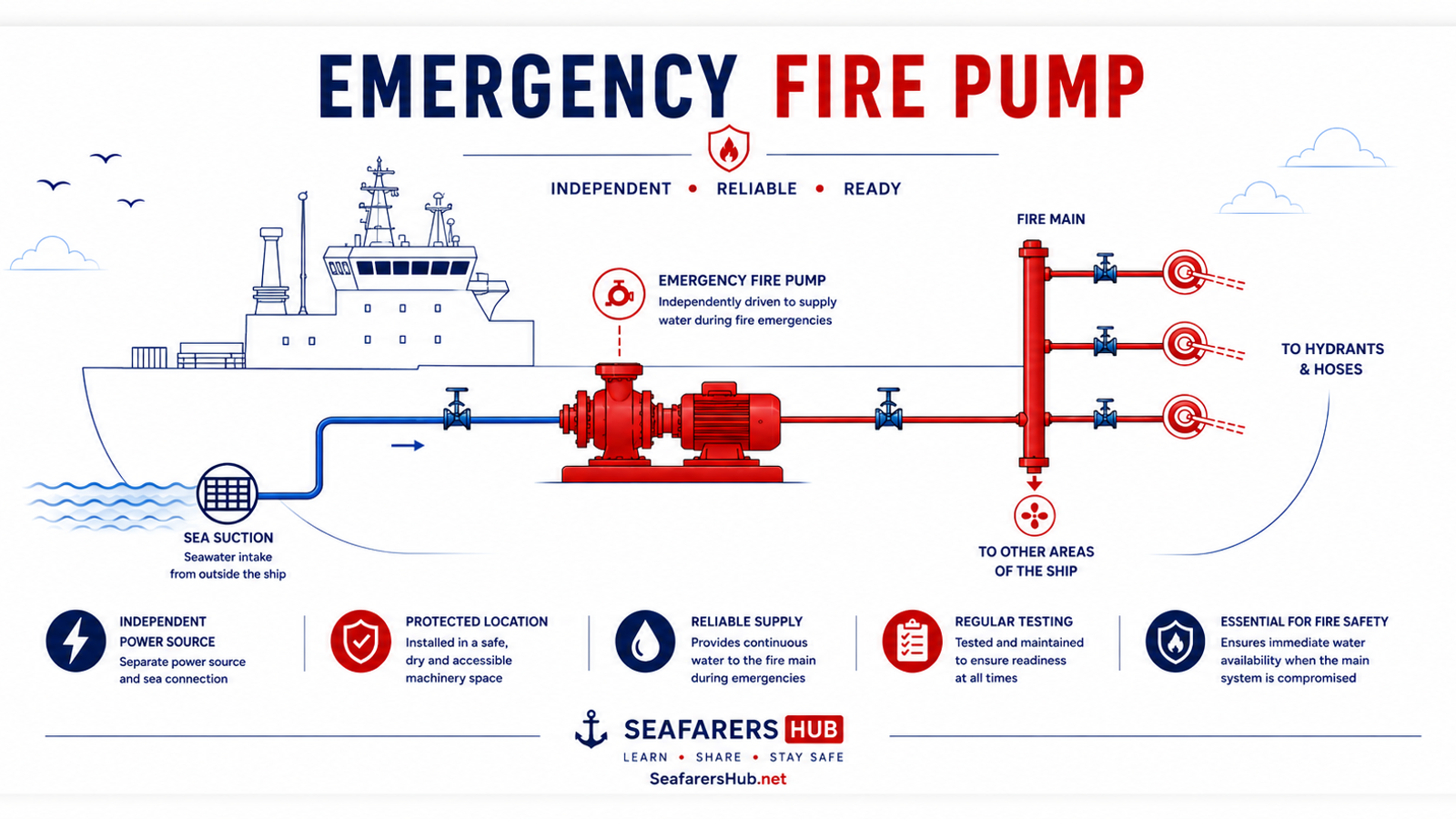
An emergency fire pump is an independent fire pump provided so that firefighting water remains available if a fire or other casualty disables the main fire pumps.
Under the FSS Code, Chapter 12, the emergency fire pump covered by that chapter is a fixed, independently driven, power-operated pump.
It supplies seawater to the ship's fire main so that hydrants and fire hoses can continue to be used during an emergency.
However, not every ship has exactly the same emergency fire-pump arrangement. SOLAS requirements depend on factors including ship type and gross tonnage.
When Is an Emergency Fire Pump Required?
The key principle is found in SOLAS II-2/10.2.2.3.
For passenger ships of less than 1,000 gross tonnage and for cargo ships, if a fire in any one compartment could put all the normal fire pumps out of action, an alternative means must be provided.
That alternative consists of an emergency fire pump complying with the FSS Code, with its source of power and sea connection located outside the space containing the main fire pumps or their sources of power.
For passenger ships of 1,000 gross tonnage and above, the arrangement is different: the sea connections, fire pumps and their power sources must be arranged so that a fire in any one compartment does not put all fire pumps out of action.