Emergency Power Supply and Emergency Switchboard on Ships: SOLAS Requirements
Learn how emergency power supply and the emergency switchboard keep essential shipboard safety services operating when the main electrical power supply fails.
SeafarersHub Editorial Team••7 min read
Share
Emergency Power Supply and Emergency Switchboard on Ships: SOLAS Requirements
A ship must remain capable of supporting essential safety services even when its main electrical supply fails. This is the purpose of the emergency source of electrical power and emergency switchboard.
The principal requirements are found in SOLAS Chapter II-1, Regulation 42 for passenger ships and Regulation 43 for cargo ships, with Regulation 44 addressing starting arrangements for emergency generating sets.
What Is the Emergency Power System?
The emergency power system is an independent electrical arrangement designed to supply specified essential services following failure of the ship's main source of electrical power.
It is important to distinguish between its main components:
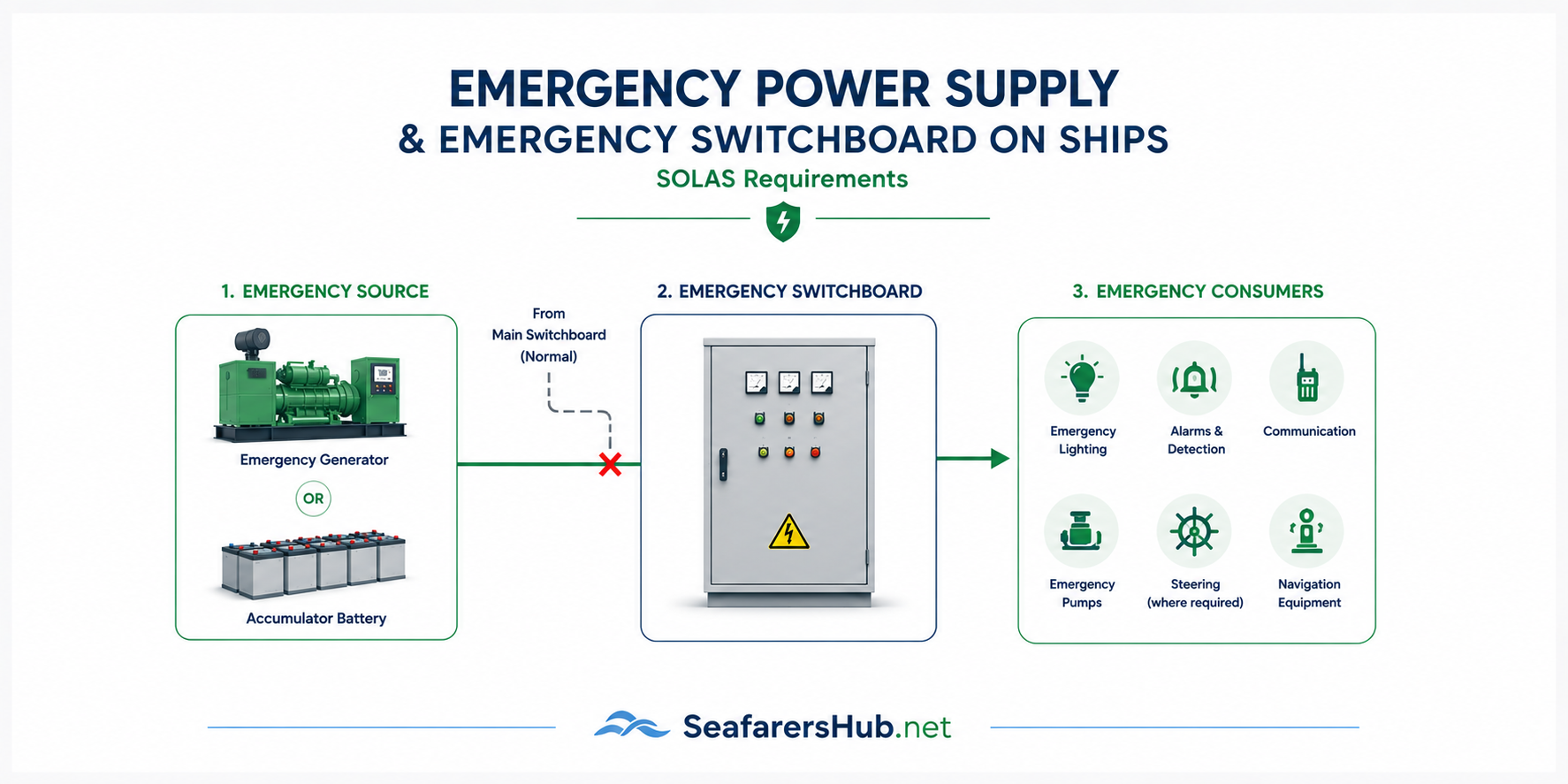
Emergency source of power → Emergency switchboard → Emergency circuits and consumers
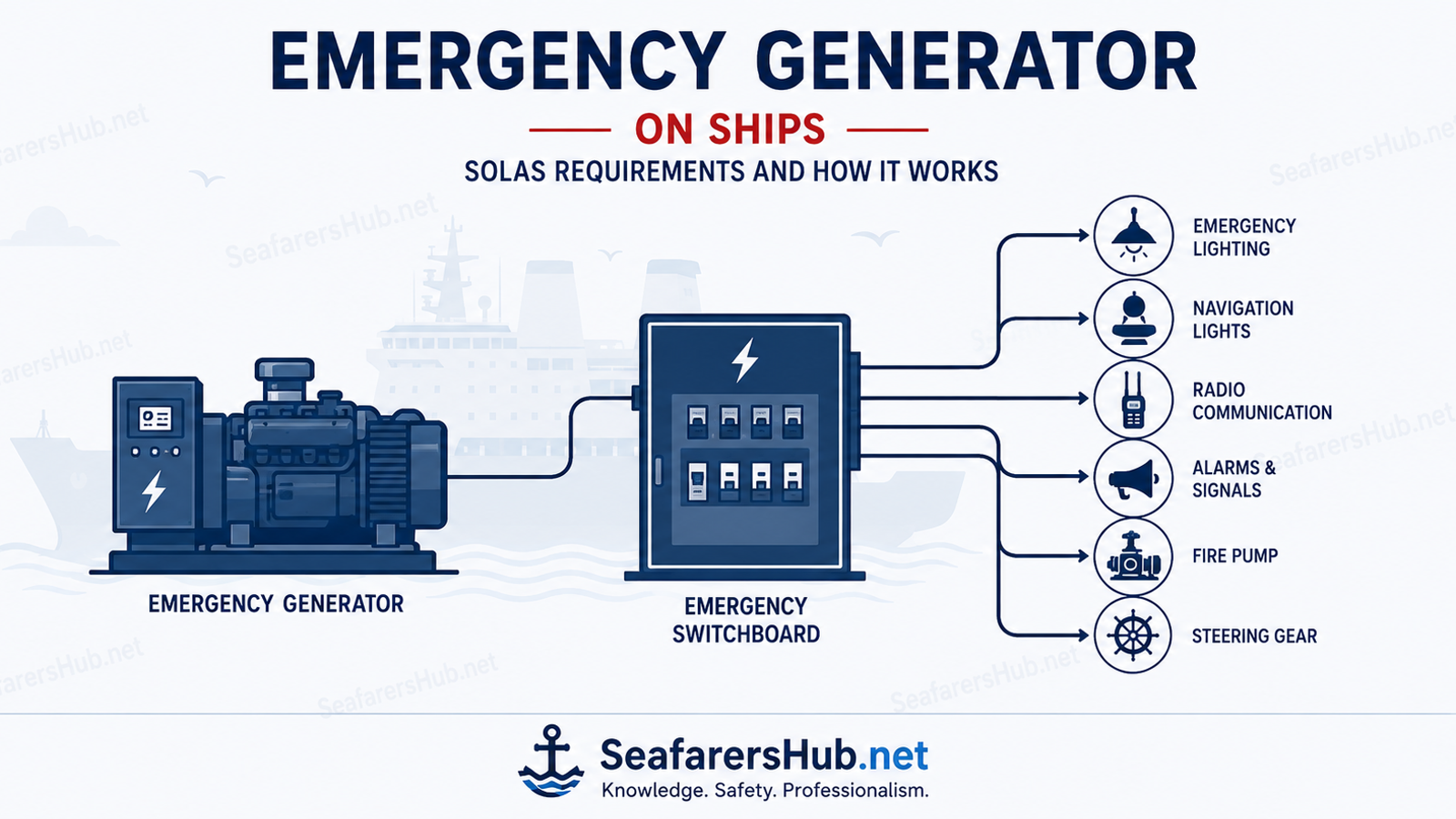
The emergency generator is therefore not the complete emergency power system. It is one possible emergency source supplying the emergency switchboard.
SOLAS permits the emergency source to be either an emergency generator or an accumulator battery, provided the applicable requirements are satisfied.
The emergency switchboard receives electrical power from the emergency source and distributes it to the emergency circuits required by SOLAS.
During normal operation, the emergency switchboard is supplied from the main switchboard through an interconnector feeder. If the main electrical source fails, this connection is automatically disconnected at the emergency switchboard so that the emergency source can supply the required emergency services.
In simplified form:
Normal condition: Main Switchboard → Emergency Switchboard
Blackout: Main Power Fails → Emergency Source → Emergency Switchboard → Essential Emergency Services
Location and Independence
One of the most important SOLAS principles is independence from the main electrical installation.
For both passenger and cargo ships, the emergency source, associated transforming equipment where applicable, transitional source, emergency switchboard and emergency lighting switchboard must generally be located above the uppermost continuous deck, readily accessible from the open deck, and not forward of the collision bulkhead.
Their location relative to the main source and main switchboard must be such that a fire or other casualty affecting the main electrical installation or a machinery space of Category A does not interfere with the supply, control and distribution of emergency electrical power.
The principle is:
One casualty should not disable both main and emergency electrical power.
Emergency Generator and Emergency Switchboard
Where the emergency source is a generator, SOLAS requires the emergency switchboard to be installed as near as practicable to the emergency source.
Normally, the emergency switchboard is located in the same space as the emergency generator, unless doing so would impair operation of the switchboard.
This arrangement reduces the dependence of the emergency system on electrical distribution through spaces that may have been affected by the original casualty.
What Happens During a Blackout?
Where an emergency generator is arranged for automatic starting, failure of the main source causes the emergency generator to start and connect automatically to the emergency switchboard in accordance with the applicable SOLAS arrangements.
The sequence can be understood simply:
Main source fails → Emergency generator starts → Generator connects to emergency switchboard → Required emergency services receive power
Where required, a transitional source of emergency electrical power, normally an accumulator battery arrangement, supplies specified services during the period before the emergency generator becomes available.
What Does Emergency Power Supply?
The emergency source is not intended simply to restore normal shipboard electrical operation.
Its purpose is to maintain the specified services essential for safety.
Depending on the ship type and applicable SOLAS requirements, these include services associated with:
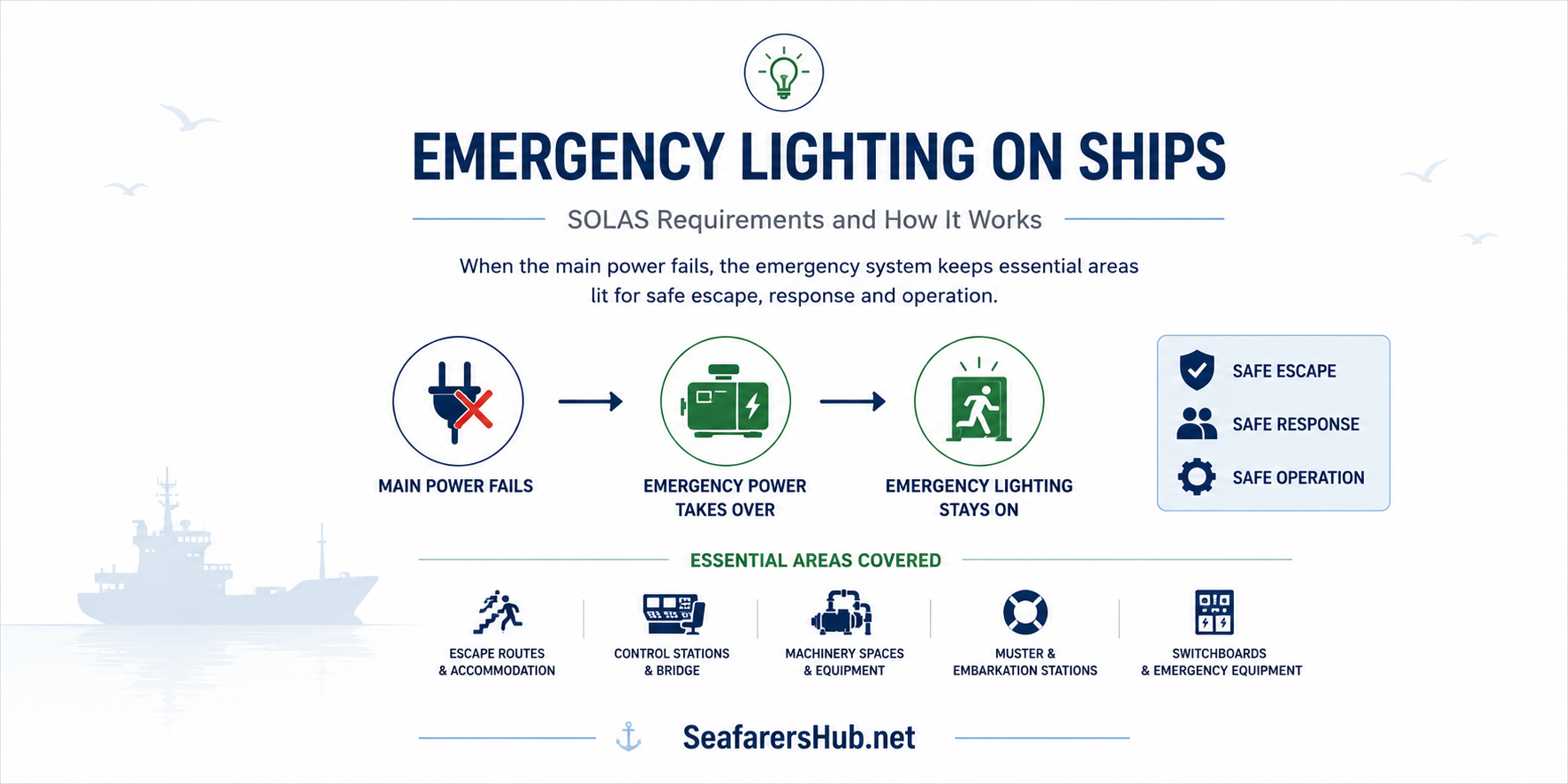
emergency lighting;
navigation lights;
communication equipment;
general alarm and fire detection systems;
essential navigation equipment;
specified emergency pumps;
steering gear where required; and
other safety-related services identified by SOLAS.
The exact loads and required supply periods differ between passenger ships and cargo ships.
Passenger Ships
For passenger ships, the principal requirements are contained in SOLAS II-1/42.
The emergency source must have sufficient capacity to supply the applicable emergency services simultaneously for the periods specified by the regulation.
Many of the principal emergency services are required for 36 hours, although SOLAS contains different durations for particular services. Therefore, 36 hours should not be interpreted as a universal duration for every emergency electrical load.
Cargo Ships
For cargo ships, the principal requirements are contained in SOLAS II-1/43.
Many specified emergency services are required for 18 hours. Some services have different durations, for example, emergency lighting at muster and embarkation stations is subject to a 3-hour requirement.
For ships regularly engaged on voyages of short duration, the Administration may accept a shorter period for specified services where an adequate standard of safety is achieved, but for the applicable 18-hour services the accepted period must not be less than 12 hours.
Automatic Disconnection of Non-Emergency Loads
The capacity of the emergency source must be protected for the services that actually matter during an emergency.
SOLAS therefore requires arrangements, where necessary, to automatically disconnect non-emergency circuits from the emergency switchboard so that electrical power remains available automatically to the emergency circuits.
This reflects an important emergency-power principle: Safety loads have priority.
The starting arrangements for emergency generating sets are addressed by SOLAS II-1/44.
Emergency generating sets must be capable of being readily started in the cold condition at the specified temperature. Where this is impracticable, heating arrangements acceptable to the Administration must be provided to ensure ready starting.
SOLAS also establishes requirements for stored-energy starting arrangements and the number of consecutives starts available.
Depending on the approved installation, starting arrangements may use electrical, compressed-air, hydraulic or other acceptable means. The regulation should therefore not be interpreted as requiring every emergency generator to use battery starting.
Testing the Emergency Power System
SOLAS requires provision for periodic testing of the complete emergency electrical system, including the automatic starting arrangements.
Testing should confirm not merely that the emergency generator engine can run, but that the emergency electrical system can perform its intended function.
From a practical shipboard perspective, this includes verifying the operation of the emergency source, automatic starting arrangements, emergency switchboard and applicable emergency consumers in accordance with the vessel's approved procedures.
The emergency source may be a generator or accumulator battery, subject to the applicable SOLAS requirements.
The emergency switchboard distributes emergency electrical power; it does not generate the power itself.
The emergency electrical installation must maintain appropriate independence from the main electrical system.
And the complete emergency electrical system must be capable of periodic testing, including its automatic starting arrangements.
Conclusion
The emergency power supply and emergency switchboard form the electrical backbone of many shipboard emergency systems.
Their purpose is not to restore every normal electrical service after a blackout. Instead, they ensure that the essential services required for the safety of the ship and persons onboard remain available when the main electrical source has failed.
Understanding this relationship makes it much easier to understand how emergency lighting, alarms, communications and other emergency systems continue operating during a blackout.