Emergency Lighting on Ships: SOLAS Requirements and How It Works
Learn how emergency lighting on ships provides essential illumination during a blackout, including key SOLAS requirements for passenger and cargo ships.
SeafarersHub Editorial Team••6 min read
Share
Emergency Lighting on Ships: SOLAS Requirements and How It Works
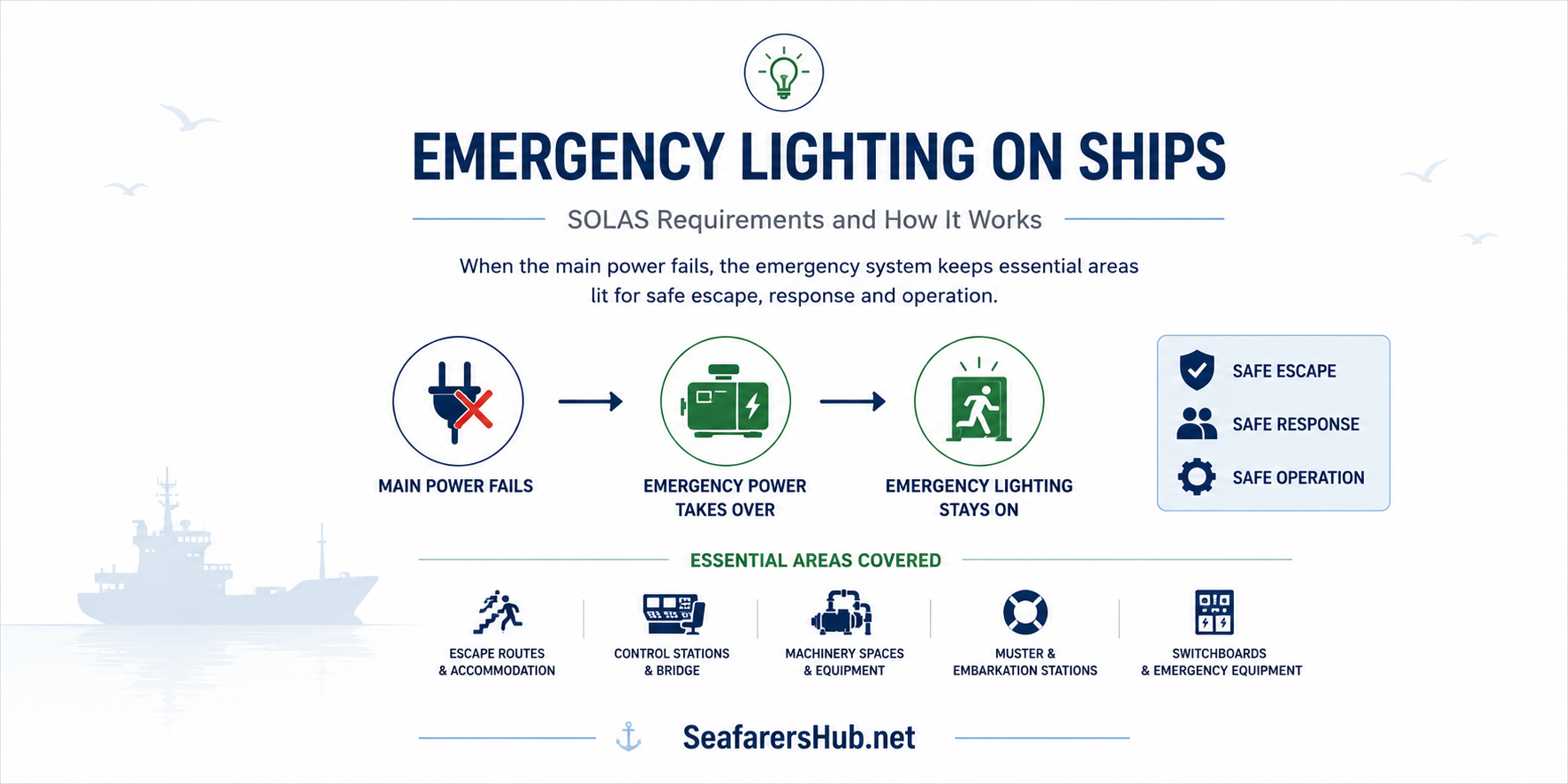
Emergency lighting is an essential part of a ship's emergency electrical system. When the main electrical supply fails, emergency lighting helps the crew and passengers move safely, locate emergency equipment, reach muster and embarkation stations, and operate essential machinery and controls.
The principal SOLAS requirements are found in SOLAS Chapter II-1, Regulation 42 for passenger ships and Regulation 43 for cargo ships.
What Is Emergency Lighting?
Emergency lighting is lighting supplied from the ship's emergency source of electrical power when normal electrical power is unavailable.
It is provided at safety-critical locations so that a blackout or other casualty does not leave essential areas in darkness.
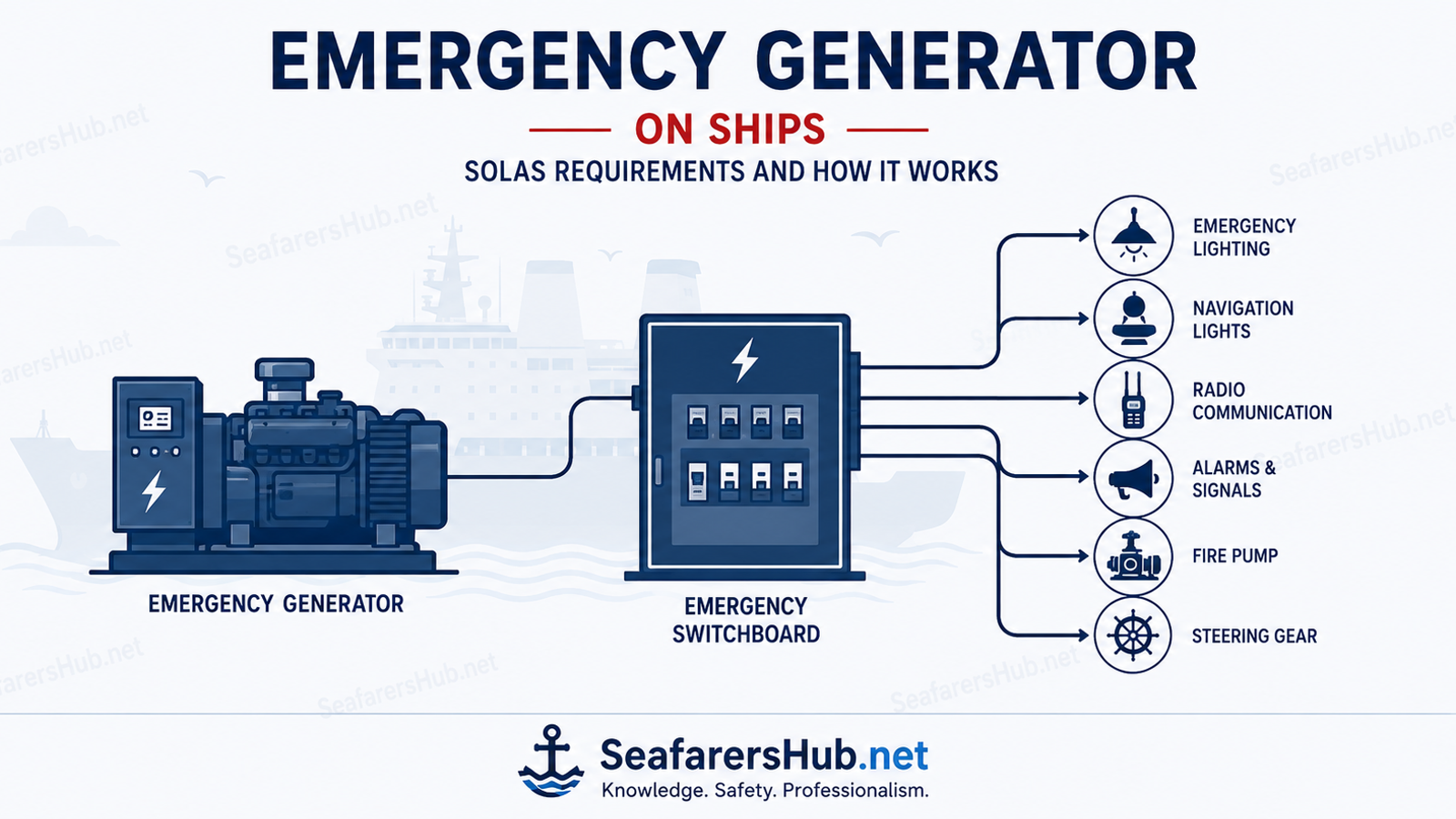
The emergency source may be an emergency generator or an accumulator battery, subject to the arrangements and requirements specified by SOLAS.
The basic principle is:
Main power fails → Emergency power becomes available → Essential emergency lighting remains operational
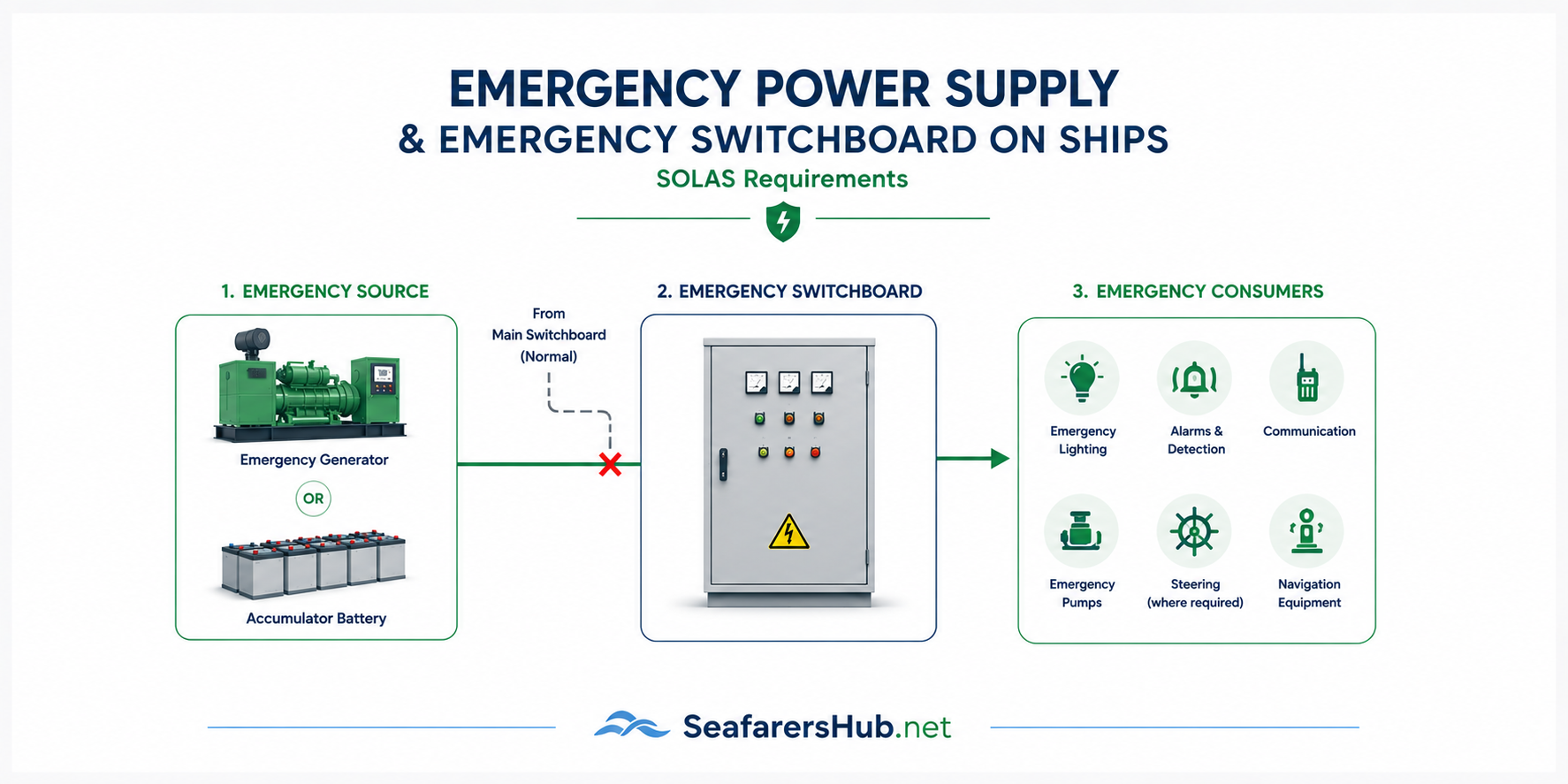
SOLAS requires a self-contained emergency source of electrical power.
The emergency source, emergency switchboard and associated equipment are arranged separately from the main source so that a fire or other casualty affecting the main electrical system does not interfere with the supply and distribution of emergency electrical power.
However, the required duration of emergency lighting differs between passenger ships and cargo ships.
Under SOLAS II-1/42, the emergency source of electrical power must generally be capable of supplying specified emergency services for 36 hours.
Emergency lighting is required at locations including:
muster and embarkation stations and over the sides;
alleyways, stairways and exits giving access to those stations;
accommodation and service-space passageways, stairways and exits;
machinery spaces and main generating stations;
control stations and machinery control rooms;
main and emergency switchboards;
locations where firemen's outfits are stored;
steering gear; and
specified emergency pumps and their starting positions.
Passenger ships therefore require a longer emergency-power endurance because of the additional safety requirements associated with carrying passengers.
Emergency Lighting on Cargo Ships
For cargo ships, SOLAS II-1/43 establishes different durations.
3 Hours
Emergency lighting must be supplied for 3 hours at: Every muster and embarkation station and over the sides, as required by the applicable SOLAS Chapter III provisions.
18 Hours
Emergency lighting must generally be available for 18 hours at specified locations including:
service and accommodation alleyways, stairways and exits;
personnel lift cars and trunks;
machinery spaces and main generating stations, including their control positions;
control stations and machinery control rooms;
main and emergency switchboards;
stowage positions for firemen's outfits;
steering gear;
the applicable fire pump;
sprinkler pump, if fitted;
emergency bilge pump, if fitted; and
their motor starting positions.
For applicable tankers constructed on or after 1 July 2002, emergency lighting is also required in cargo pump-rooms.
SOLAS permits the Administration, for a ship regularly engaged on voyages of short duration, to accept a shorter period for specified Regulation 43 emergency services where an adequate level of safety is achieved, but not less than 12 hours.
Passenger Ships vs Cargo Ships
Ship type
General emergency-lighting duration
Passenger ship
36 hours
Cargo ship – muster & embarkation stations
3 hours
Cargo ship – specified emergency locations
18 hours
These durations should not be applied interchangeably. The applicable requirement depends on the type of ship, location and service being supplied.
How Does Emergency Lighting Work?
During normal operation, the ship's main electrical system supplies normal lighting.
Following failure of the main electrical supply, the ship's emergency electrical arrangements provide power to the required emergency services.
A simplified sequence is:
Main electrical supply fails → Emergency source operates → Emergency switchboard supplies essential circuits → Emergency lights remain available
The emergency source and its associated equipment are positioned and arranged to maintain independence from failures affecting the main electrical source.
Transitional Emergency Lighting
Where the emergency source is a generator, SOLAS also provides requirements for a transitional source of emergency electrical power.
This is typically an accumulator battery arranged to supply specified emergency services automatically and without interruption for the required transitional period while the emergency generator becomes available.
This helps prevent critical areas from remaining completely dark during the transition from main power to emergency generator power.
Supplementary Lighting on Ro-Ro Passenger Ships
SOLAS contains additional requirements under Regulation II-1/42-1 for passenger ships having ro-ro cargo spaces or special category spaces.
Among these requirements, passenger public spaces and alleyways must have supplementary electric lighting capable of operating for at least three hours when all other electrical power sources have failed.
Portable rechargeable battery-operated lamps are also required in specified crew spaces unless the required supplementary emergency lighting is provided.
Testing and Maintenance
Emergency lighting must be ready for immediate use during a blackout or casualty.
Shipboard inspection and testing should therefore confirm that:
emergency lights operate correctly;
emergency lighting circuits remain functional;
emergency generator or battery arrangements are operational;
emergency switchboard arrangements are maintained;
transitional emergency power operates correctly where applicable; and
emergency lights and escape routes remain clearly identifiable.
SOLAS also requires provision for periodic testing of the complete emergency electrical system, including automatic starting arrangements.
Why Is Emergency Lighting Important?
A blackout can occur during a fire, flooding, machinery failure or electrical casualty.
Without emergency lighting, crew members and passengers may have difficulty finding escape routes, firefighting equipment, emergency controls or muster stations.
Emergency lighting therefore supports several essential functions:
Blackout → Emergency power → Emergency lighting → Safe escape and emergency response
Conclusion
Emergency lighting is a critical component of a ship's emergency electrical system.
SOLAS requires emergency lighting at locations essential for escape, muster, firefighting, machinery operation and emergency control, but the required duration differs between passenger and cargo ships.
For seafarers, it is important to know which areas are supplied by emergency lighting, how emergency power is provided, and how the system is tested onboard.
Learn More
Explore our complete guide to Ship Emergency Systems for an overview of the key emergency arrangements every seafarer should understand.