Emergency Bilge Suction on Ships: SOLAS Requirements and How It Works
Serious machinery-space flooding can develop quickly following a seawater pipe failure, damaged valve or other major leakage.
The normal bilge system may not be sufficient to deal with large quantities of water. Ships are therefore provided with an emergency bilge suction arrangement that can use a large-capacity pump to remove accumulated water from the machinery space.
The principal requirements are contained in SOLAS Chapter II-1, Regulation 35-1 – Bilge pumping arrangements.
Regulatory basis: This article uses the SOLAS Consolidated Edition 2024 as its primary reference. Exact SOLAS regulations are identified where regulatory requirements are discussed.
Learn more: Ship Emergency Systems: A Complete Guide for Seafarers | SeafarersHub
What Is Emergency Bilge Suction?
Emergency bilge suction is an arrangement for removing large quantities of water accumulated in the machinery space.
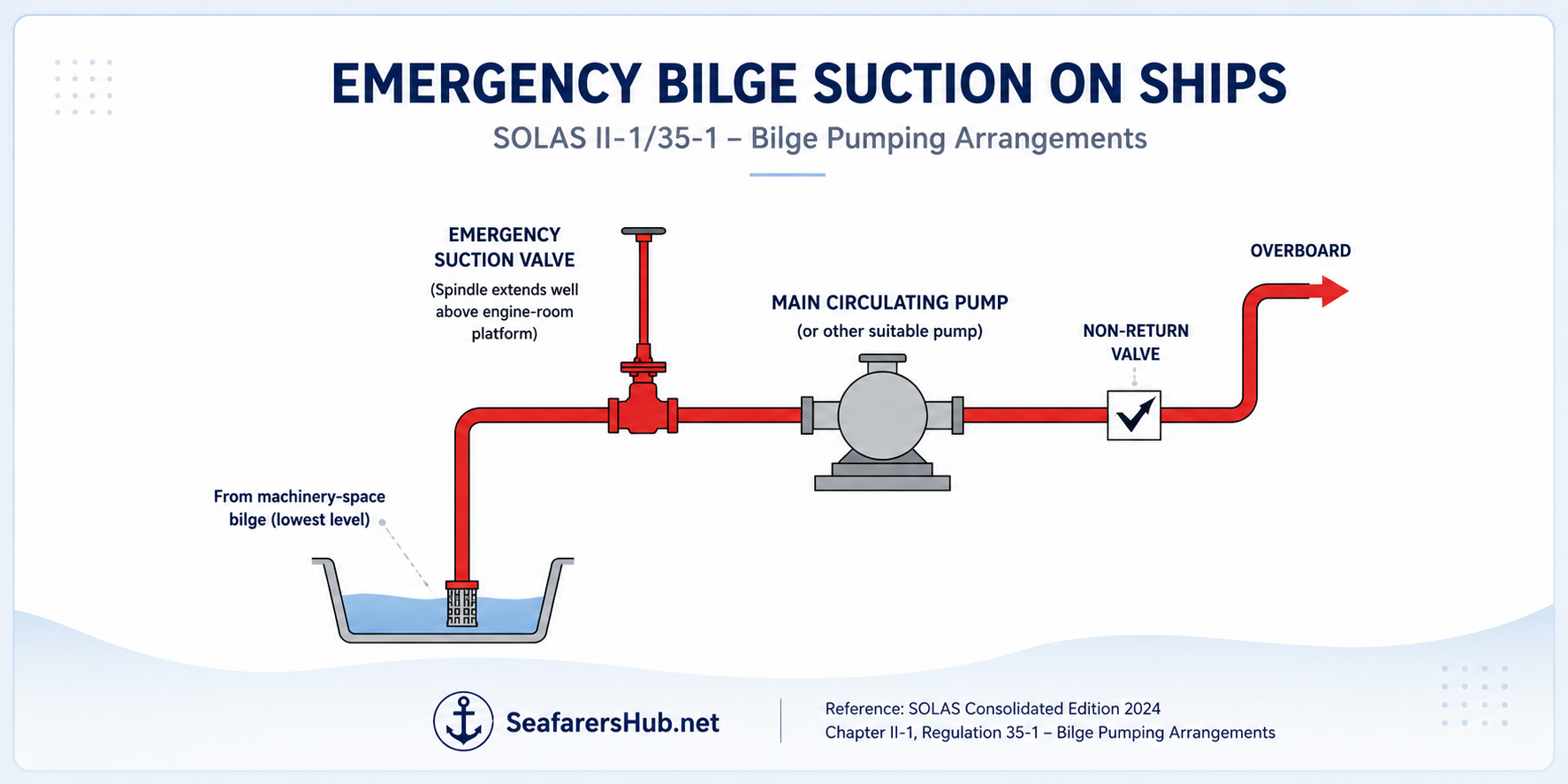
Unlike the normal bilge system, it provides a large, relatively direct suction path between the machinery-space drainage level and a suitable pump.
In simple terms:
Machinery-space flooding → emergency bilge suction → large-capacity pump → overboard
It is important to understand that emergency bilge suction is an arrangement, not necessarily a separate emergency bilge pump.
Normal Bilge Suction vs Emergency Bilge Suction
The normal bilge system is used to remove water collected in bilge wells and other drainage points during normal operation.
Emergency bilge suction is intended to provide additional pumping capability when large quantities of water accumulate in the machinery space.
Therefore:
Normal bilge system → normal drainage
Emergency bilge suction → serious machinery-space flooding
SOLAS II-1/35-1 also contains requirements for direct bilge suctions, which should not be confused with the emergency bilge suction arrangement.
What Pump Is Used?
Under SOLAS II-1/35-1.3.7, the emergency arrangement may use the ship's main circulating pump.
For a motorship, the direct suction pipe to the machinery-space drainage level must have the same diameter as the pump inlet.
For a steamship, it must be at least two-thirds of the diameter of the pump inlet.