Emergency Air Compressor on Ships: SOLAS Requirements and How It Works
Learn how emergency air compressors support shipboard starting-air systems, emergency generator starting and dead-ship recovery, with key SOLAS requirements.
SeafarersHub Editorial Team••9 min read
Share
Emergency Air Compressor on Ships: SOLAS Requirements and How It Works
A ship may lose its normal electrical power and, in a more severe situation, reach a dead-ship condition in which the main propulsion plant, boilers and auxiliaries are not operating and the stored energy needed to restore essential machinery is assumed unavailable
An emergency air compressor may be provided for this purpose, depending on the ship's machinery and emergency arrangements. It may also form part of the starting arrangement for an emergency generating set where that generator uses compressed-air starting.
However, an important distinction must be made:
SOLAS does not require every ship to have the same emergency air-compressor arrangement.
The relevant requirements are principally associated with SOLAS II-1/44 – Starting arrangements for emergency generating sets and SOLAS II-1/26.4 – recovery from the dead-ship condition.
An emergency air compressor is a compressor that may be provided as part of a ship's emergency starting or machinery-recovery arrangements, depending on the vessel's approved design.
Depending on the vessel's design, its function may be associated with:
maintaining compressed-air starting capability for an air-started emergency generating set; or
developing or restoring starting air needed during recovery from a dead-ship condition.
These functions should not be confused because they arise from different regulatory contexts.
The actual purpose and arrangement of the emergency air compressor must therefore be determined from the ship's approved machinery drawings, manuals and procedures.
Emergency Air Compressor and the Emergency Generator
Emergency generators do not all use the same starting method.
Depending on the approved installation, an emergency generating set may use an electrical, hydraulic or compressed-air starting arrangement.
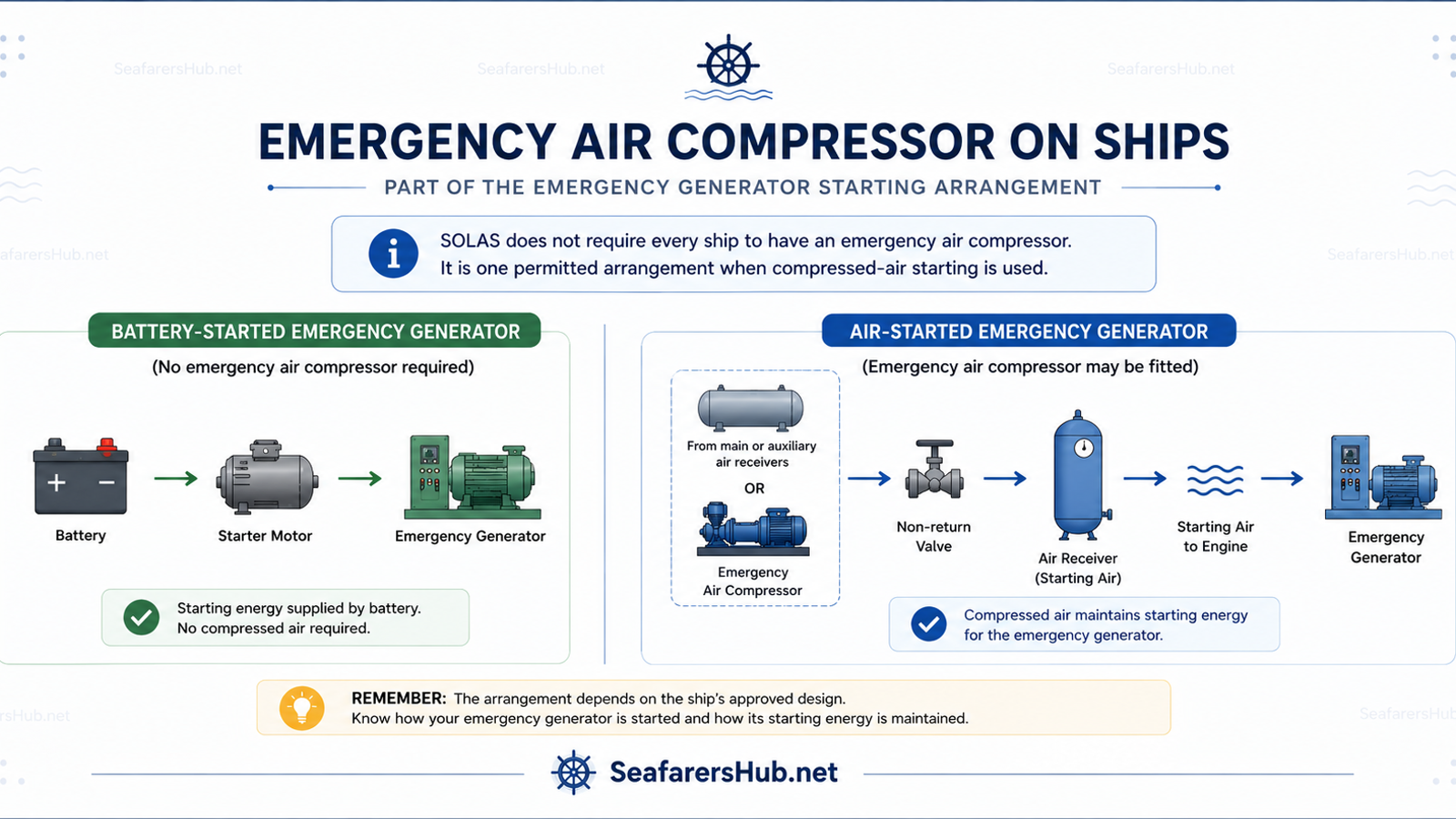
Where compressed-air starting is used, SOLAS II-1/44 permits the compressed-air starting system to be maintained from:
Main or auxiliary air receivers → suitable non-return valve → emergency generator starting-air system
or by:
Emergency air compressor → emergency generator starting-air system
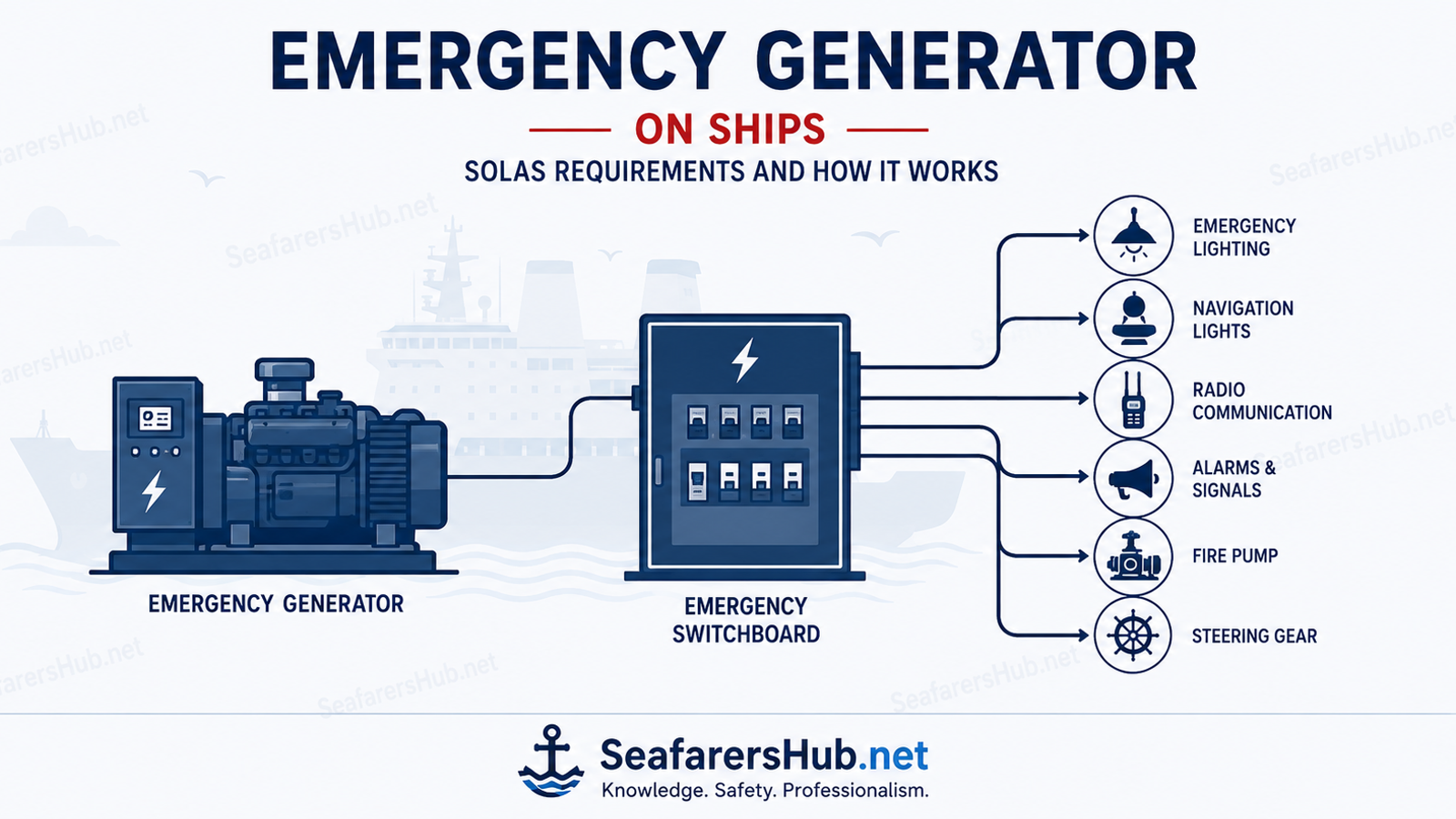
If the emergency air compressor used for this purpose is electrically driven, SOLAS requires it to be supplied from the emergency switchboard.
Therefore, an emergency air compressor is not universally required for starting the emergency generator.
What If the Emergency Generator Is Battery-Started?
Many emergency generating sets use electrical starting.
A simplified arrangement is:
Starting battery → starter motor → emergency generator
In this arrangement, an emergency air compressor is not involved in starting the emergency generator.
However, this does not necessarily mean that the ship has no emergency air compressor.
A compressor may have another function within the vessel's approved machinery-recovery arrangement, particularly in connection with restoring starting capability following a dead-ship condition.
This distinction is essential when discussing emergency air compressors.
What Is a Dead-Ship Condition?
SOLAS II-1/26.4 requires machinery arrangements that allow the ship's machinery to be brought into operation from the dead-ship condition without external aid.
The applicable IMO unified interpretation describes a dead-ship condition as one in which the main propulsion plant, boilers and auxiliaries are not operating and stored energy for starting and operating the propulsion plant, main source of electrical power and other essential auxiliaries is assumed unavailable.
In other words, the ship must have an arrangement that enables it to begin recovering its essential machinery using resources available on board.
Emergency Air Compressor and Dead-Ship Recovery
Starting air can be critical to recovering machinery on ships whose diesel engines use compressed-air starting.
The IMO unified interpretation of SOLAS II-1/26.4 specifically addresses how the initial starting air or electrical power necessary to bring main and auxiliary machinery back into operation can be developed onboard without external assistance.
Where the ship's emergency generator complies with the applicable SOLAS requirements, it may be used as part of restoring the main propulsion plant, boilers and auxiliaries, provided the associated power supplies necessary for engine operation have the required protection.
One possible ship-specific recovery sequence is: Emergency generator starts → emergency electrical power becomes available → emergency air compressor operates, where provided for this purpose → starting-air pressure is restored → essential auxiliaries/main electrical power are recovered → propulsion machinery is prepared for restart
An emergency air compressor may form part of this recovery process where provided by the ship's approved design.
This sequence is an example rather than a universal arrangement. The actual recovery sequence varies between ships.
An Important SOLAS Distinction
The emergency air compressor mentioned under SOLAS II-1/44 and an emergency air compressor associated with dead-ship recovery should not automatically be treated as identical arrangements.
Under II-1/44, SOLAS specifically states that an electrically driven emergency air compressor used to maintain the compressed-air starting system of the emergency generating set is supplied from the emergency switchboard.
For the dead-ship provisions, the requirements are different.
The IMO interpretation states that where there is no qualifying emergency generator available for recovery, the initial starting air or electrical power must be capable of being developed onboard without external aid. If an emergency air compressor or electric generator is required for that purpose, it is to be powered by a hand-starting oil engine or a hand-operated compressor, and the required starting energy and associated power supplies are to be available within 30 minutes of the dead-ship condition.
This distinction is important when interpreting the actual arrangement fitted on a particular vessel.
How Is the Emergency Generator Starting Energy Maintained?
For an emergency generating set arranged for automatic starting, SOLAS II-1/44 requires stored starting energy sufficient for at least three consecutive starts.
A second source of energy must also be available for three additional starts within 30 minutes, unless manual starting can be demonstrated to be effective.
SOLAS also specifies how the stored energy is maintained:
Electrical and hydraulic starting systems are maintained from the emergency switchboard.
Compressed air starting systems may be maintained from the main or auxiliary air receivers through a suitable non-return valve or by an emergency air compressor. If that compressor is electrically driven, it is supplied from the emergency switchboard.
These requirements apply specifically to the starting arrangements for the emergency generating set.
Why Is the Non-Return Valve Important?
Where the emergency generator's starting-air receiver is supplied from the main or auxiliary compressed-air system, SOLAS requires a suitable non-return valve.
This arrangement allows the emergency generator's starting-air receiver to be supplied from the ship's compressed-air system while maintaining the required separation of the emergency starting arrangement.
SOLAS further specifies that the relevant starting, charging and energy-storing devices are located in the emergency generator space and are dedicated to operation of the emergency generating set, subject to the permitted connection from the main or auxiliary compressed-air system.
Emergency Air Compressor vs Main Air Compressor
These terms should also be distinguished.
The main air compressors normally maintain the ship's starting-air system during normal operation. They provide compressed air according to the vessel's machinery arrangement, including starting air for applicable diesel engines.
An emergency air compressor provides an additional compressed-air capability associated with a particular emergency or recovery function.
Its exact purpose depends on the ship.
Therefore, it is better to think of the distinction as:
Main air compressor → normal starting-air supply
Emergency air compressor → compressed-air source provided for a specific emergency starting or machinery-recovery function according to the ship's approved design
This is more accurate than assuming that every emergency air compressor exists solely to start the emergency generator.
Testing and Maintenance
An emergency air compressor must be capable of performing its intended function when required.
Practical checks may include:
compressor starting and operation;
air-receiver pressure;
electrical or independent power supply, as applicable;
air leakage;
suction and discharge valves;
non-return valves;
lubricating-oil condition;
drains and moisture accumulation;
pressure controls and safety devices; and
starting-air piping and connections.
These are practical maintenance considerations rather than a universal SOLAS checklist.
Testing and maintenance should always follow the vessel's approved procedures, planned maintenance system, manufacturer's instructions and applicable statutory and classification requirements.
Common Problems
Problems that may prevent successful operation include:
low air-receiver pressure;
air leakage;
compressor starting failure;
incorrect valve alignment;
non-return valve problems;
electrical or mechanical faults;
excessive moisture;
lubrication problems; and
inadequate maintenance.
The compressor should never be considered in isolation. Its power source, receiver, valves, piping and the machinery it is intended to support all form part of the overall arrangement.
What Should Seafarers Know?
Engineering personnel should know the actual purpose of the emergency air compressor fitted on their vessel.
They should understand its location, power source, starting procedure, associated air receiver, valve arrangement and the machinery it is intended to support.
Most importantly, engineers should know whether the compressor is associated with:
emergency-generator starting, dead-ship recovery, or another approved ship-specific arrangement.
They should also understand the vessel's complete dead-ship recovery procedure and the sequence required to restore electrical power, starting air, essential auxiliaries and propulsion.
The arrangement found on one vessel should never automatically be assumed to apply to another.
Final Thoughts
The emergency air compressor is an important but sometimes misunderstood part of shipboard emergency machinery.
Under SOLAS II-1/44, it may be used to maintain compressed-air starting energy for an emergency generating set. Where the compressor serving this function is electrically driven, it is supplied from the emergency switchboard.
Emergency compressed-air capability may also form part of a vessel's dead-ship recovery arrangement. SOLAS II-1/26.4 requires machinery to be capable of being brought back into operation from the dead-ship condition without external aid, while the actual means of developing the necessary starting energy depends on the approved ship arrangement.
The key lesson for seafarers is therefore not simply:
“Where is the emergency air compressor?”
It is:
“What is our emergency air compressor designed to do, how is it powered, and where does it fit into our ship's emergency and dead-ship recovery arrangements?”
Understanding those answers before a blackout or dead-ship condition occurs is an important part of machinery-space preparedness.
References
International Maritime Organization (IMO). SOLAS Consolidated Edition 2024, Chapter II-1, Regulation 26 — Machinery installations, including Regulation 26.4.
International Maritime Organization (IMO). SOLAS Consolidated Edition 2024, Chapter II-1, Regulation 44 — Starting arrangements for emergency generating sets.
International Maritime Organization (IMO). MSC.1/Circ.1464/Rev.1 — Unified Interpretations of SOLAS Chapters II-1 and XII, including the interpretation of SOLAS II-1/26.4 concerning the dead-ship condition.