Officer of the Watch Duties: Responsibilities, Decision-Making and Safe Navigation
The Officer of the Watch is the Master’s representative during the navigational watch, responsible for safe navigation, collision avoidance, passage monitoring, bridge equipment and timely escalation when conditions become unsafe.
SeafarersHub Editorial Team••8 min read
Share
The Officer of the Watch (OOW) is not simply the person supervising the bridge for a four-hour period. Under the STCW watchkeeping framework, the OOW acts as the Master’s representative and carries primary responsibility for the safe navigation of the vessel during the watch, with particular attention to collision avoidance and prevention of grounding.
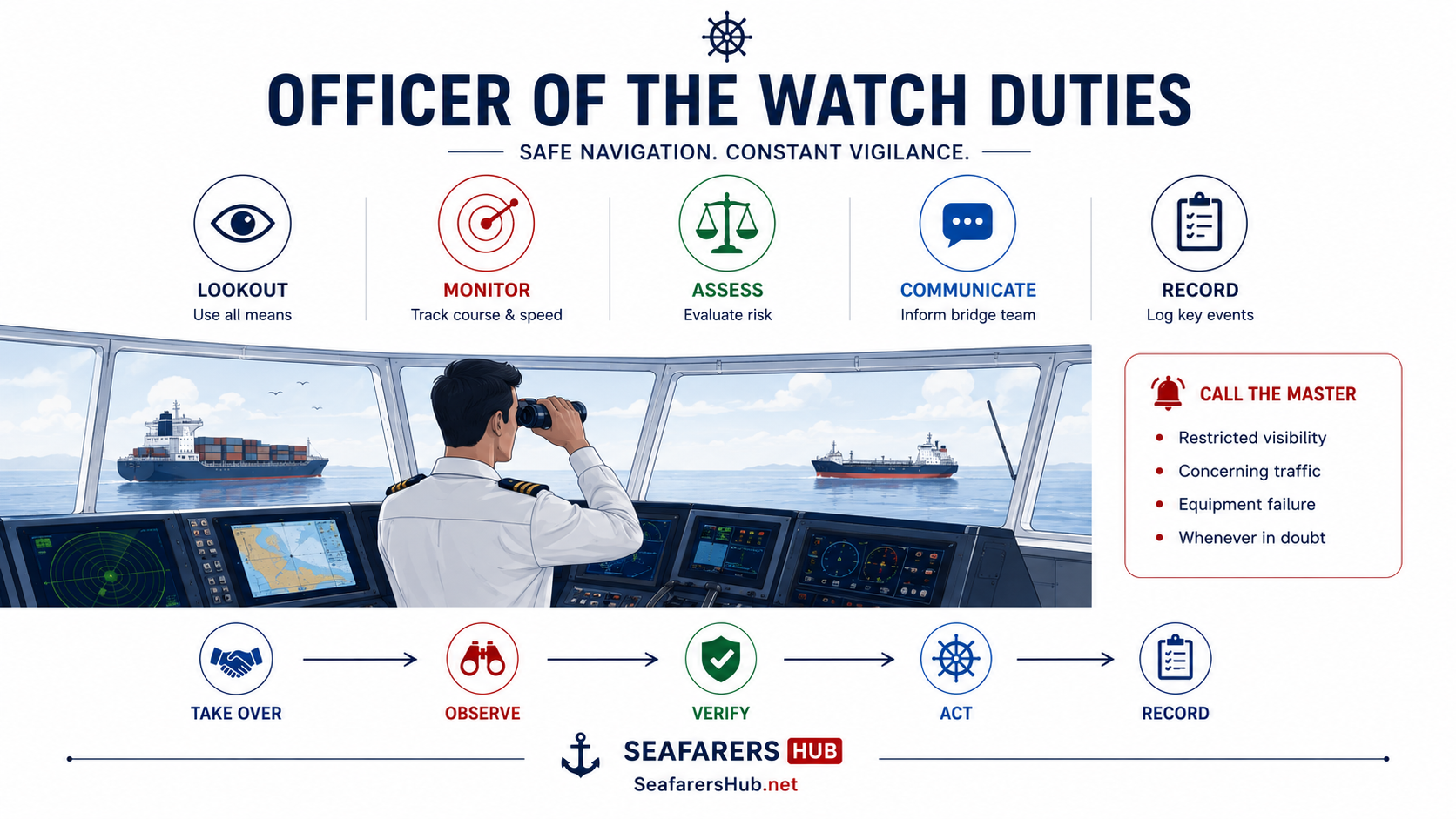
That responsibility requires much more than monitoring ECDIS or radar. A competent OOW must maintain an effective lookout, continuously verify the vessel’s position and movement, assess traffic and environmental risks, understand equipment limitations, comply with COLREG, manage the bridge team, maintain proper records and know when the Master must be called.
1. Responsibility Begins Before Taking Over the Watch
A safe watch starts with a professional handover.
The relieving officer should personally establish the vessel’s position, intended track, course, speed and draught and understand the expected navigational situation. Weather, visibility, tides, currents, nearby traffic, navigational hazards, compass errors, equipment status and the Master’s standing or special orders must also be understood before assuming responsibility.
The watch must not be transferred if the relieving officer appears incapable of performing the duties effectively. If a collision-avoidance manoeuvre or other significant navigational action is already in progress, the handover should normally be delayed until the action is completed.
This is important because a signed watch-handover checklist does not itself prove that situational awareness has actually been transferred.
2. Maintain a Proper Lookout
The OOW must ensure that a proper lookout is maintained at all times.
Lookout is not limited to visually observing vessels ahead. It involves systematic use of:
Sight and hearing
Radar and ARPA
AIS where appropriate
ECDIS and position information
Compass and heading information
Sound signals
VHF and relevant traffic information
Environmental and navigational observations
STCW permits the OOW to act as sole lookout in daylight only when the situation has been carefully assessed and it is established that doing so is safe, considering factors such as visibility, traffic density, weather and proximity to navigational dangers.
This should never become a routine assumption simply because conditions initially appear quiet.
3. Continuously Monitor the Passage
An approved passage plan does not remove the need for active navigation.
During the watch, the OOW must check the vessel’s course, position and speed at sufficiently frequent intervals to confirm that the ship continues to follow the planned route. IMO voyage-planning guidance also emphasizes close and continuous monitoring of the ship’s position and progress during execution of the voyage.
Monitoring should consider more than cross-track distance.
Depending on the navigational situation, the OOW should evaluate:
Distance from dangers
Under-keel clearance
Wheel-over positions
No-go areas
Traffic separation requirements
Set and drift
Expected currents
Changes in weather or visibility
Position-source integrity
Arrival at reporting points
Pilot boarding arrangements
Contingency and abort points
In coastal and congested waters, position fixing should be sufficiently frequent and, where circumstances allow, supported by independent methods. The STCW Code specifically calls for independent position checks at appropriate intervals when ECDIS is used.
4. Collision Avoidance Is an Active Process
The OOW must comply with the International Regulations for Preventing Collisions at Sea (COLREG).
Professional collision avoidance can be viewed as a continuous cycle:
Detect → Assess → Decide → Act → Verify
Radar, ARPA and AIS provide valuable information, but none replaces the requirement to assess the situation professionally.
The OOW should determine whether risk of collision exists early enough to avoid creating a close-quarters situation. Once avoiding action is taken, its effectiveness must be monitored until the vessels are finally past and clear.
STCW specifically requires OOWs using radar to remain mindful of COLREG requirements and requires radar to be used in restricted visibility and congested waters with due regard to its limitations.
A displayed CPA value should therefore be treated as decision-support information, not as permission to stop monitoring the encounter.
5. Understand the Bridge Equipment — and Its Limitations
The OOW is expected to know the location and operation of the ship’s navigational and safety equipment and understand its limitations.
On a modern bridge this may include:
ECDIS
Radar and ARPA
AIS
GNSS receivers
Gyrocompass
Magnetic compass
Echo sounder
Speed log
BNWAS
Autopilot or heading-control system
Rate-of-turn indicator
VHF/GMDSS equipment
Steering controls and alarms
The critical principle is cross-verification.
A GNSS fault, incorrect gyro input or sensor-selection error can affect several interconnected bridge systems simultaneously. Multiple displays agreeing with one another therefore do not necessarily constitute independent confirmation.
Operational tests of navigational equipment should also be conducted as circumstances permit, particularly before hazardous navigational conditions and before port arrival or departure.
6. Know When to Call the Master
One of the most important OOW skills is knowing when the situation has exceeded the limits of a normal watch.
STCW identifies circumstances in which the Master should be notified immediately, including:
Restricted visibility encountered or expected
Traffic movements causing concern
Difficulty maintaining course
Failure to obtain expected land, navigational marks or soundings
Unexpected changes in soundings
Failure of propulsion, steering or essential navigational equipment
Radio-equipment malfunction
Heavy-weather concerns
Encountering navigational hazards
Any emergency
Any situation in which the OOW is in doubt
Calling the Master does not mean waiting passively for the Master to arrive.
Where immediate action is necessary for the safety of the vessel, the OOW must take that action.
7. The Master on the Bridge Does Not Automatically Relieve the OOW
This is one of the most important professional distinctions in bridge watchkeeping.
The OOW remains responsible for safe navigation even when the Master is physically present on the bridge until the Master specifically states that responsibility has been assumed and both parties understand that the transfer has occurred.
A Master entering the bridge, examining radar or issuing a single instruction does not by itself constitute formal relief of the OOW.
Clear command transfer is essential, particularly during pilotage, heavy traffic, restricted visibility and emergencies.
8. Pilot on Board Does Not Remove Bridge-Team Responsibility
The presence of a pilot does not relieve the Master or OOW of their duties for the safety of the ship.
The OOW should continue to:
Monitor the ship’s position
Compare movement against the passage plan
Observe traffic
Monitor helm and engine orders
Check under-keel clearance
Confirm communications
Challenge unexpected actions
STCW requires close cooperation with the pilot and continued accurate monitoring of the vessel’s position and movement. If the OOW is uncertain about the pilot’s actions or intentions, clarification should be sought; unresolved doubt requires notifying the Master and taking necessary action.
9. Restricted Visibility Changes the Watch
When restricted visibility is encountered or expected, the bridge condition must change accordingly.
The OOW should implement the applicable COLREG requirements, inform the Master, ensure a proper lookout is posted, exhibit the correct navigation lights, use radar and ensure the vessel proceeds at an appropriate safe speed with machinery readiness consistent with the circumstances.
The key professional mistake is waiting for visibility to become severely restricted before strengthening the bridge team.
Preparation should occur when deterioration is expected, not only after it happens.
10. Do Not Allow Secondary Tasks to Take Over the Watch
STCW states that the OOW should not undertake duties that interfere with the safe navigation of the vessel.
This matters on modern ships because the bridge officer may simultaneously face:
Emails
Port documentation
Checklists
GMDSS duties
Arrival paperwork
Chart administration
Company reporting
Security communications
Administrative workload must never reduce navigational awareness.
If the operational situation demands the OOW’s full attention, navigation takes priority.
11. Record What Matters
A proper record of navigational movements and activities must be maintained during the watch.
Depending on the vessel and company procedures, records may include:
Positions and course changes
Weather and visibility
Master called/on bridge
Pilot embarkation
Engine status
Equipment failures
Navigational warnings
Traffic events
Significant communications
Passage-plan deviations
Emergency or abnormal actions
Good records should describe what actually occurred, not merely demonstrate that a checklist was completed.
They may later become critical evidence during internal investigations, Port State Control inspections or casualty investigations.
12. Fatigue Is a Navigational Risk
A technically competent officer can still become an unsafe watchkeeper when fatigued.
IMO fatigue guidance identifies fatigue as a risk to seafarer health, operational safety, security and environmental protection and emphasizes that fatigue management is a shared responsibility involving seafarers, companies and Administrations.
Current Port State Control procedures also identify deficient watch arrangements, absence of qualified watch personnel and inability to provide sufficiently rested watchkeepers as significant STCW compliance issues.
Hours-of-rest records should therefore represent actual working conditions rather than exist merely to satisfy inspection paperwork.
The bridge officer is not employed simply to keep the ship on a track line.
The professional OOW continuously builds and updates a mental picture of the vessel’s position, surrounding traffic, environmental conditions, equipment reliability and future risk.
Good watchkeeping is therefore proactive rather than reactive.
The strongest question an OOW can continuously ask is:
“What could change in the next few minutes, and am I already prepared for it?”
References
International Maritime Organization. (1978). International Convention on Standards of Training, Certification and Watchkeeping for Seafarers, 1978, as amended. International Maritime Organization.
International Maritime Organization. (1999). Guidelines for voyage planning (Resolution A.893(21)). International Maritime Organization.
International Maritime Organization. (2010). Adoption of amendments to the Seafarers’ Training, Certification and Watchkeeping Code (STCW/CONF.2/34). International Maritime Organization.
International Maritime Organization. (2019). Guidelines on fatigue (MSC.1/Circ.1598). International Maritime Organization.
International Maritime Organization. (2025). Procedures for Port State Control, 2025 (Resolution A.1206(34)).International Maritime Organization.