What Is MARPOL Annex VI? A Guide to Air Pollution from Ships
What Is MARPOL Annex VI?
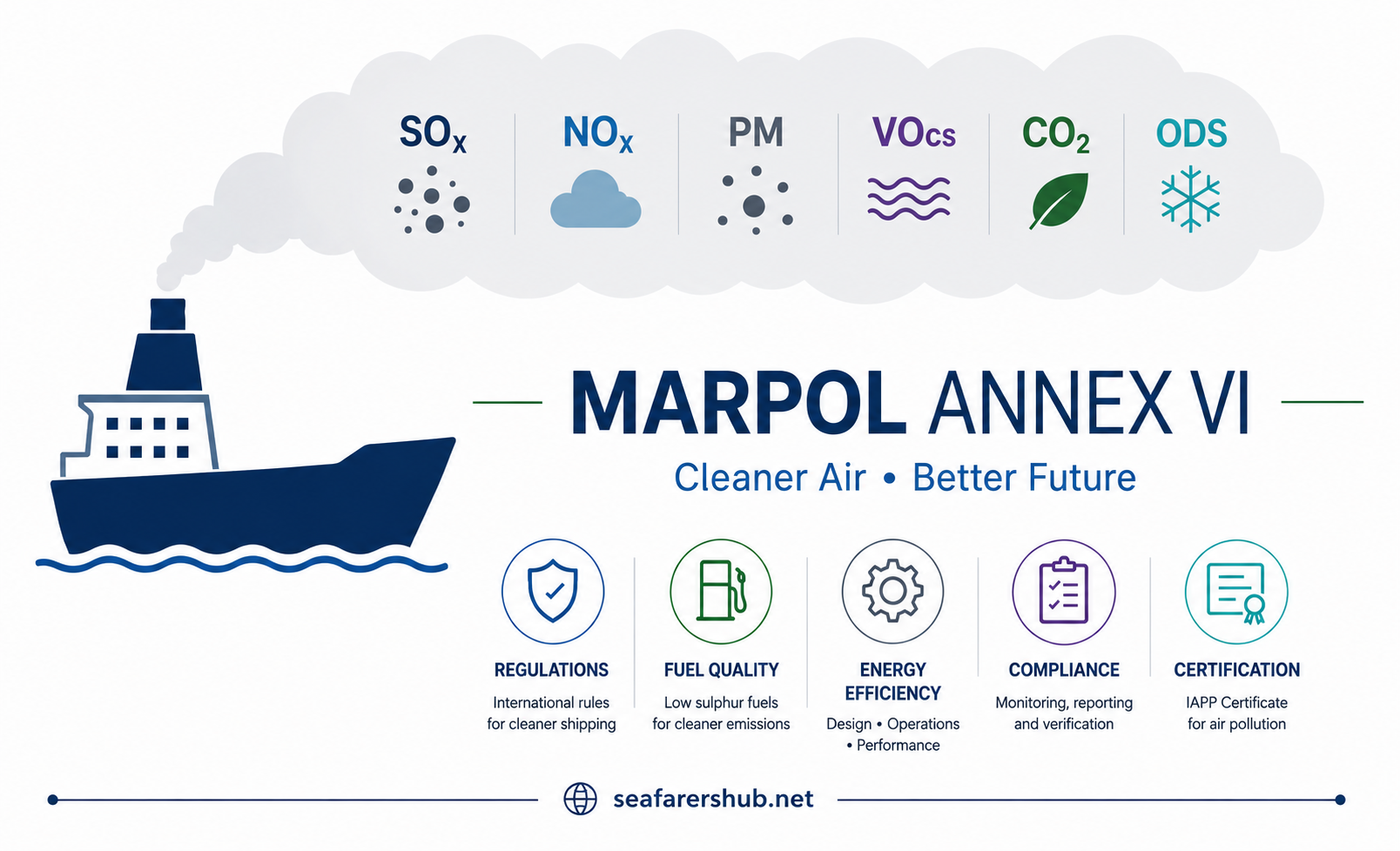
MARPOL Annex VI contains the international requirements for the prevention of air pollution from ships.
It regulates major sources of ship emissions, including:
- Nitrogen oxides (NOx);
- Sulphur oxides (SOx) and particulate matter;
- Ozone-depleting substances (ODS);
- Volatile organic compounds (VOCs);
- Shipboard incineration; and
- Fuel oil quality.
Annex VI also includes requirements for ship energy efficiency and carbon intensity, including EEDI, EEXI, SEEMP and CII.
Learn More About: What Is MARPOL? Complete Guide to the Six Annexes | SeafarersHub
NOx Emissions – Regulation 13
Regulation 13 controls NOx emissions from marine diesel engines.
It generally applies to engines with a power output of more than 130 kW, subject to specified exemptions.
NOx limits are divided into:
Tier I → basic NOx limits
Tier II → stricter limits
Tier III → strictest limits for applicable ships operating in designated NOx Emission Control Areas
Engine compliance is closely linked to the NOx Technical Code 2008, EIAPP certification and the engine Technical File.
SOx and Fuel Sulphur – Regulation 14
The maximum sulphur content of fuel oil is:
Global limit → 0.50% m/m
SOx Emission Control Areas → 0.10% m/m
Ships may use approved equivalent methods, such as exhaust gas cleaning systems, where applicable.
Emission Control Areas
Emission Control Areas (ECAs) impose stricter controls on ship emissions.
Important Annex VI ECAs include the Baltic Sea, North Sea, North American area, United States Caribbean Sea area and Mediterranean Sea.
The Mediterranean SOx ECA requirements took effect on 1 May 2025. The Canadian Arctic and Norwegian Sea ECA amendments entered into force on 1 March 2026, further expanding Annex VI emission controls.
Fuel Oil Quality – Regulation 18
Annex VI controls the quality of fuel supplied to ships.