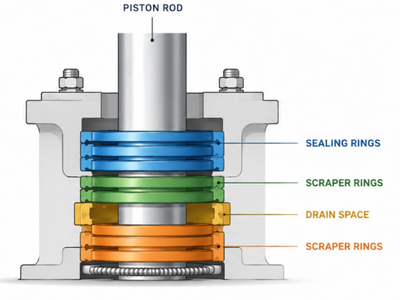
A stuffing box has three main sections:
- Upper section – prevents the residuals of cylinder lubricating oil and gases (scavenge air and any gas blow-by piston rings) from passing down to the crankcase.
- Middle section – allows draining of oil if there is any carry-over from the upper or lower parts and leading it to outside the engine to a dirty oil drain tank.
- Lower section – prevents crankcase lubricating oil passing upward and entering the scavenge space.
The ‘upper section’ is also referred to as the ‘sealing section’. The ‘middle section’ is also referred to as the ‘drain section’. The ‘lower section’ is also referred to as the ‘scraping section’. Each name indicates the section’s function. The sealing section forms a gas seal, the drain section allows for draining of oil, whilst the scraping section is responsible for scraping of crankcase lubricating oil back into the crankcase to prevent oil loss.
This article focuses on the stuffing boxes used within two-stroke slow speed marine diesel engines. These types of engine have a small bore-to-stroke ratio, which means that a crosshead must be used in order to limit the size of the crankcase. Without a crosshead, the crankcase would be uneconomically wide and sealing between the piston rings and cylinder liner would become difficult.
What is the purpose of an engine stuffing box?
The main functions of an engine stuffing box are, to:
- Prevent crankcase lubricating oil entering the scavenge space when the piston rod moves upwards.
- Prevent scavenge air from entering the crankcase when the piston moves upwards or downwards.
- Prevent cylinder lubricating oil entering the crankcase when the piston rod moves downwards.
- Prevent debris entering the crankcase when the piston rod moves downwards.
- Prevent exhaust gases entering the crankcase (if the piston rings are not sealing correctly) when the piston moves upwards or downwards.
What are the main parts of an engine stuffing box?
The main parts of a stuffing box are listed below:
Stuffing Box Housing
The stuffing box housing forms the outer casing that encloses the sealing rings and scraper rings. It is typically constructed from cast iron or steel and assembled from two parts.
Sealing Rings
Sealing rings are primarily responsible for preventing scavenge air entering the crankcase. If the piston rings should be passing (allowing gases to pass from the combustion space to the scavenge space), the sealing rings will also prevent these gases from entering the crankcase. Sealing rings fit into grooves within the stuffing box housing and are typically manufactured from bronze. As it is not possible to assemble the rings within the stuffing box as a single piece, each ring is formed by three or four different sections which connect together to form a circle.