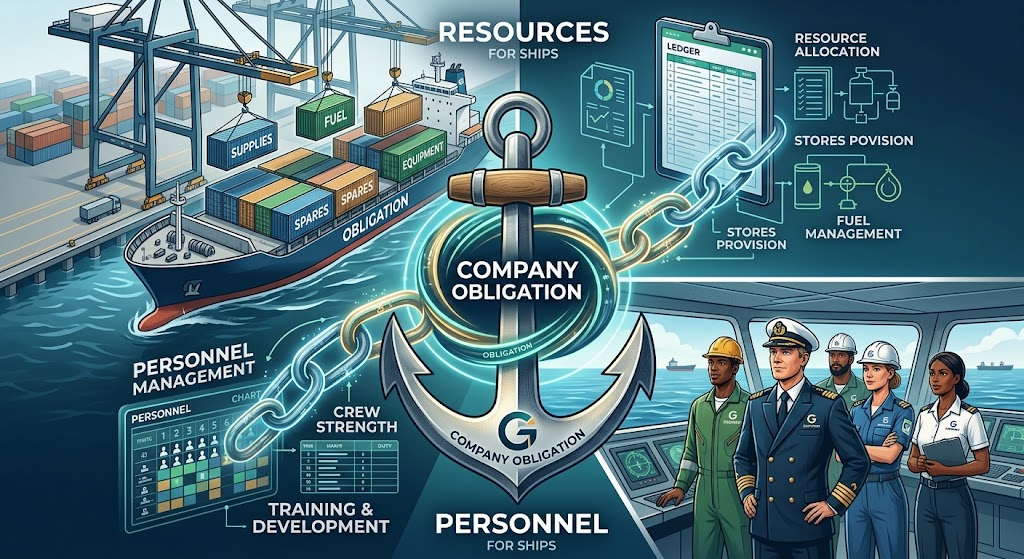
Clause 3.3 of the ISM Code: Adequate Resources and Shore-Based Support
Clause 3.3 of the ISM Code requires shipping companies to provide adequate resources and shore-based support so that the Designated Person Ashore can perform safety and pollution-prevention duties effectively. This support includes qualified personnel, technical expertise, emergency assistance, communication systems, training, financial resources, and direct access to senior management
SeafarersHub Editorial Team••9 min read
Share
The company's duty to enable the designated person to perform an effective safety role
Introduction
Safe shipping depends on far more than the competence of the master and crew. A ship may have capable seafarers and a written safety management system, yet still be exposed to danger if it cannot obtain technical advice, spare parts, additional personnel, emergency assistance, training, or management decisions in time.
The International Safety Management (ISM) Code recognizes this reality by placing clear responsibility on the company that operates the ship. Clause 3.3 states that the company is responsible for ensuring that adequate resources and shore-based support are provided so that the designated person or persons can carry out their functions. Although brief, this provision is a key safeguard against the isolation of ships and against safety systems that exist only on paper.
The requirements of ISM Code are implemented through the company's safety management system (SMS), which connects shore management, the designated person ashore, masters, officers, and ratings.
Clause 3.3 is particularly important because it requires the company to turn safety policy into practical capability. It makes the company answerable for ensuring that the person appointed to monitor safety and pollution-prevention matters has the people, authority, information, time, and support necessary to act effectively.
The wording and context of Clause 3.3
“The Company is responsible for ensuring that adequate resources and shore-based support are provided to enable the designated person or persons to carry out their functions.”
Clause 3.3 appears in Section 3, Company Responsibilities and Authority, immediately before Section 4, Designated Person(s). Its position is deliberate. Clause 3.2 requires the company to define and document the responsibilities, authority, and relationships of personnel who manage, perform, and verify work affecting safety and pollution prevention.
Clause 3.3 then requires that the designated person be supported in practical terms. Section 4 explains why: every company should designate a person or persons ashore to ensure the safe operation of each ship and to provide a link between the company and those on board. The designated person must have direct access to the highest level of management and is responsible for monitoring safety and pollution-prevention aspects of each ship's operation.
The word 'responsible' is significant. The obligation belongs to the company, not only to the DPA. A company cannot meet the clause simply by appointing a qualified person and then expecting that person to solve every problem without authority, budget, staff, or access to decision makers. Similarly, the expression 'ensuring' requires more than making resources theoretically available. The company must establish and maintain a reliable arrangement through which the DPA can obtain support in a timely manner. If recurring shortages prevent the DPA from fulfilling the role, the company has not achieved the practical purpose of Clause 3.3.
What “adequate resources” means
The ISM Code does not provide a fixed list or an identical budget for every company. Adequacy must be judged in relation to the size of the fleet, type and complexity of vessels, trade, cargoes carried, operational risks, and the level of support required during normal operations and emergencies.
A small domestic operator may need a simple but robust system, while an international tanker or passenger-ship company will require broader technical, operational, legal, and emergency capability. In both cases, the resources must be sufficient for the DPA to perform the assigned functions effectively.
Human resources are the first requirement. The DPA needs enough time to monitor ships, analyze reports, visit vessels where appropriate, follow up corrective actions, and communicate with management. One person cannot provide meaningful oversight for a large and complex fleet if that person also carries several unrelated full-time commercial duties.
Depending on the organization, the DPA may need assistance from safety officers, marine superintendents, technical superintendents, environmental specialists, auditors, trainers, and administrative staff. Competence matters as much as headcount: those supporting the DPA should understand the vessel type, the SMS, applicable regulations, and the hazards involved.
Financial resources are equally essential. A safety management system cannot function if recommended training, repairs, surveys, spare parts, audits, or corrective actions are repeatedly postponed for lack of money. The company should provide an identifiable process for considering safety-related expenditure and for authorizing urgent actions.
This does not mean that every request must be accepted without evaluation. It means that the DPA must be able to raise a justified need, receive a timely management decision, and escalate a concern when delay would create an unacceptable risk. Top management should be able to demonstrate that safety resources are planned, reviewed, and available when needed.
Information and communication resources also fall within the ordinary meaning of adequacy. The DPA needs current access to vessel status, incident reports, near-miss reports, maintenance defects, audit findings, risk assessments, crew competence records, and relevant regulatory information. Ships need dependable means to contact the DPA, including alternatives when normal communications fail. Modern support may include secure document-management systems, maintenance databases, tracking systems, video or telephone consultation, and emergency communication arrangements. Technology alone is not enough; the information must reach a competent person who can understand it and act.
Meaning of shore-based support
Shore-based support is the practical assistance that connects the ship with the company's wider capability. It includes:
A. An emergency contact arrangements made readily accessible 24/7
B. Marine and technical advice, maintenance coordination, procurement, crewing support.
C. legal or insurance contact, environmental response expertise, and access to external specialists.
D. The required support will vary, but it must be available quickly enough to be useful.
A contact number that is not answered, a superintendent without authority to arrange repairs, or a long approval chain during an emergency does not satisfy the intention of Clause 3.3.
Technical support is an obvious example. If a ship reports a failure of steering gear, propulsion, cargo equipment, fire-fighting system, or pollution-prevention equipment, the DPA must be able to involve appropriate technical personnel and ensure that the defect is assessed, controlled, repaired, or reported as necessary.
Operational support may be required when a master faces heavy weather, port restrictions, a navigation concern, unsafe cargo conditions, fatigue issues, or a medical emergency. In these cases, the DPA does not replace the master's command authority. Instead, shore support provides expert advice, extra resources, and a direct route to senior management while the master retains the ability to make urgent safety decisions.
Emergency preparedness is another important dimension. The DPA should have access to an emergency response structure capable of assisting ships after collisions, groundings, fires, oil spills, cyber incidents, security threats, or serious injuries. This may involve company personnel, contracted response organizations, classification societies, salvage experts, pollution-response contractors, or insurers. Clause 3.3 does not require every company to employ all expertise internally. However, where outside support is used, the company must ensure that the arrangements are suitable, known to relevant personnel, and capable of being activated without confusion or unacceptable delay.
How Clause 3.3 operates in practice
Consider a ship that repeatedly reports defects in a critical piece of safety equipment. The DPA should examine the reports, assess the operational risk, consult technical personnel, and ensure that suitable action is taken. If the repair requires a port call, spare part, service engineer, or temporary operating limitation, the DPA must be able to obtain the necessary shore decision and resources. The company cannot treat the issue as solely the ship's problem. Clause 3.3 requires the company to support the DPA in ensuring that the vessel is safely managed.
A second example concerns fatigue and manning. If the DPA receives reports that work-rest requirements are not being met because of inadequate manning, excessive port operations, or repeated administrative demands, the DPA should be able to investigate and propose practical measures. These may include additional personnel, adjusted schedules, relief arrangements, or changes in work allocation. The company must take the concern seriously because fatigue can impair navigation, maintenance, emergency response, and decision making. Resource adequacy includes providing a realistic means for the ship to operate safely, not merely maintaining a minimum number on a manning document.
A third example is a cyber or communications failure. A vessel may lose access to critical operational systems or its normal means of contacting shore. Adequate shore-based support includes access to competent technical assistance and alternative communications. The DPA needs clear authority to mobilize IT or operational specialists, evaluate the impact on safe navigation and cargo operations, and advise the master and management. This illustrates that Clause 3.3 applies to changing operational risks as well as traditional machinery and navigation problems.
Evidence of compliance and the role of audits
During verification of an SMS, auditors may look beyond the wording of the manual. A formal statement promising support is important, but it is not enough. Objective evidence can include the DPA's job description and reporting line; qualifications and workload; safety and training budgets; records of management review; correspondence showing escalation of concerns; incident investigations; corrective-action records; emergency drills; contracts with external support providers; and examples of resources supplied in response to shipboard needs. These records show whether the company has made Clause 3.3 a living part of its management system.
Auditors may also speak with masters, officers, superintendents, and the DPA to determine whether they understand the support arrangements. Useful questions include: Can a ship reach knowledgeable help at any time? Does the DPA have authority to contact senior management directly? Are safety requests tracked and resolved? Is there a process for urgent expenditure? Does the company learn from incidents and near misses? A negative pattern, such as repeated unresolved defects or a history of discouraging reports, may demonstrate that resources and support are not adequate even if the SMS contains the correct words.
Conclusion
1. Clause 3.3 of the ISM Code places a vital obligation on the company: it must provide adequate resources and shore-based support so that the designated person can perform the role on safety and pollution prevention and linking ships with senior management.
2. The clause recognizes that responsibility without support is ineffective. A DPA needs sufficient time, competence, authority, information, communication tools, financial access, and specialist assistance to respond to the actual risks of the fleet.
3. Effective compliance is therefore measured by practice, not appointment alone. The company must ensure that the DPA can obtain timely decisions, mobilize technical and emergency support, raise concerns directly to top management, and verify that corrective actions are completed. When those arrangements work, Clause 3.3 strengthens the entire safety management system: crews are not left alone with unresolved risks, management receives accurate safety information, and the company is better able to prevent casualties and marine pollution. In this way, the clause turns the ISM Code's safety objectives into an operational responsibility shared across ship and shore.
References
1. International Maritime Organization (IMO). Resolution A.741(18): International Management Code for the Safe Operation of Ships and for Pollution Prevention (International Safety Management (ISM) Code), sections 3 and 4.
2. International Maritime Organization (IMO). Revised Guidelines for the Operational Implementation of the International Safety Management (ISM) Code by Companies, MSC-MEPC.7/Circ.8.
3. International Association of Classification Societies (IACS). Recommendation No. 41: Guidance for IACS Auditors to the ISM Code, paragraph 3.3.
4. UK Maritime and Coastguard Agency. Guidance on the International Safety Management Code, interpretation of company support for the designated person.
5. Australian Maritime Safety Authority. Designated persons: operational-safety guidance.